Showing posts with label Review. Show all posts

Sunday, January 2, 2022

Review: Sailing to Byzantium

Still enjoying some of Science Fiction's classics, I'm re-reading Robert Silverberg's award winner, and enjoying it again, after all these years, though it raises some questions, at least in my mind...

Some novellas deserve to be full novels, and Sailing to Byzantium is one of them. Robert Silverberg wrote this cross-genre jewel -- a mix of SF, fantasy, time travel, romance and mystery -- in 1984 and, deservedly, it won the Nebula Award. 

In fact, the real mystery is why it hasn’t been filmed long before now, because it has the makings of a gloriously visual movie, especially in this age of CG effects, when the spectacular visuals (laid out in a narrative that must have been mind-bending in its day) can be brought to life in 3D.

The other mystery, equally confounding,  is why Silverberg took an immense story that touches on so many subjects, and invested only a novella’s length in it. The plot is simple enough, to be sure; but the world he explores in a scant 40k words remains arresting almost forty years since the Hugo and Nebula were awarded. A novella, for this story? One wonders ... why?!
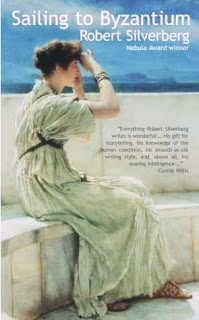
In the fiftieth century, the world as we know it is gone (no surprise there), and the homogenized descendants of humanity are a comparative handful of functional immortals: physically perfect, they are masters of a magical technology which enables them to live as what one can only term 
eternal tourists, forever traveling from one fantastic city to another. 

The rub is this: every city is a recreation of one of history’s great metropolises, raised from dust by legions of machines, permitted to exist for a short time then demolished, no doubt to be cannibalized for the materials to build another. 

All the great cities of history are being recreated, five at a time (the limit is firmly imposed, no reason given, but one can hypothesize about the availability of materials, or the machinery that makes it all go). And the immortal citizens of the fiftieth century simply travel, party, enjoy, socialize, and generally have a great time among the grandeur and the teeming populations of ‘temporaries,’ who appear to be androids, possibly even hard-light holograms, all of them whisked into existence to complete the illusion of Alexandria, or Chang-An, or Constantinople itself.

Only a tiny percentage of the human population don’t enjoy the eternal lifestyle. One in a thousand, or perhaps ten thousand, still grow old. After an extended youth, when the aging comes upon them, they age rapidly. Such is Gioia, the lovely young thing with whom Charles Phillips falls in love. And Charles himself is the other, and even rarer, anomaly. 

Hes a ‘visitor’ in the future: synthetic body and mind, machine-designed and built to bring the past to vibrant life for the entertainment (and perhaps the education) of the citizens, who -- by our standards -- often seem callow, and occasionally even moronic.

Charles isn’t the only visitor, but there’s barely a handful like him, constructs drawn from whatever century. Being synthetic, he’s a misfit, greater than the ‘temporaries’ but lesser than the citizens. Gioia is drawn to him as like is drawn to like: she also is a misfit, doomed to age with an incurable genetic condition. 

When the rapid aging begins she flees, and as Charles literally pursues her around the world, city to city, he discovers what he is. Not a twentieth century man at all; not even a naturally-born human … something more, he decides, not less. Being synthetic, he's as timeless as the physically perfect (and intellectually somewhat dense) citizens; but what of Gioia, who is aging alarmingly. What can be done for her, amid this kaleidoscope of incredible technology?

The prose is stylish and rich and the world building tantalizing. If Sailing to Byzantium were double or triple the length, properly fleshed out and with the panoply of amazing concepts fully explored, it would make a novel today’s reader would deem awesome. At 40k words, it seems oddly abbreviated, in places thin to the point of anorexia. Silverberg has remarked on how the novella is a format he likes a great deal, and he clearly had a fine time here. But the material demanded, and deserved more.

Nebula and Hugo Awards notwithstanding, and as much as I adore Robert Silverberg, I want to give Sailing four stars rather than five, because it surely needed more growth, more investment, just more, to work truly brilliantly. It might have read better in 1984. Current readers -- in this age of hundred-episode sagas on tv and book series running many thousands of pages -- are seldom satisfied when thematic material is underdone. Sailing has a ‘rare’ quality, perfect on the outside but a tad too pink in the middle to suit all tastes. Which isn’t to say I don’t love this story -- I do! But my imagination runs away on flights of creative fantasy, filling in the blanks and building the sumptuous, thick novel I wish Robert Silverberg has written.

Sunday, December 12, 2021

Review: Swordspoint


This seems to be the season for re-reading classic SF and fantasy, and I'm enjoying it vastly. From Poul Anderson (
The Van Rijn Method) to Frank Herbert (Dune) and Robert Heinlein (Starman Jones), this voyage through the past of a genre I adore has been a lot of fun. So much fun, I don't see myself stopping anytime soon! So let's take a look at a fantasy which was a standout novel in its day.

Here's a seriously good read that came out in the mainstream press in the late 1980s, published by Arbor House in 1987. Ellen Kushner was out on a limb ... her bio says she was very well connected in the industry, so she could probably afford the risk. 

Also, to be fair, and thorough, Anne Rice (who sadly passed away just a couple of days before I find myself writing this ... a sad loss to the world or literature in general and vampires in particular) had "broken trail" with her epic stories of vampire stories and Cry to Heaven, but Kushner was going in different directions .. lgbt fantasy.

There's still a dire shortage. Have you ever tried to hunt down something like Lord of the Rings or Game of Thrones, where the love interest is between the heroes? Like an lgbt version of Conan the Barbarian, or Ladyhawke, for instance. Few lgbt writers seem to have an affinity for fantasy worlds, and more's the pity.

So, Swordspoint was unique in two ways when it appeared. It has overt lgbt relationships -- gasp! In a book released by a mainstream publisher back in those days! -- and its story is set in a fantasy realm.

(Other lgbt fantasy novels I'm thinking of are The Swordsman and The Lords of Harbendane, both by Keegan; The Last Herald Mage series by Lackey; the Nightrunner series by Flewelling ... and so on. But all too soon you'll find yourself drifting off into SF, worlds of the weird, flat-out erotica, vampires, zombies, anything but "pure" fantasy as I'll always think of it. Call me old fashioned.)

It was a nice surprise when Swordspoint came along. It's a "literary" kind of fantasy, so if you were hoping for a "down and dirty, raunchy, sword-swinging, dragon-slaying gay romp", this isn't the book for you. Swordspoint has a quasi-Sixteenth Century Europe, court of the Medici sort of setting, with Oscar Wilde's style of dialog, a sophisticated fantasy backdrop, and characters whose sensual preference leans toward the lgbt. A comedy of manners, as well as errors. 

It's not explicit, and it is delightful. The plot concerns intrigue, courtly characters, menace and danger. The central character is the gorgeous Richard St. Vier, a duellist, and there's enough action, drama and derring do to satisfy someone whose other guilty pleasure is, uh, Errol Flynn. (In fact, Gene Wolf said in his review of this novel, this is "the book we might have had if Noel Coward had written a vehicle for Errol Flynn." Very cool indeed.)

If the novel has a downside, it's that it's sometimes inclined to get a bit too clever with the repartee and witty, Coward/Wilde style dialog. In today's world this tends to make dialog sound "stilted" -- people don't talk that way. You wonder if they ever actually did. 

In all honesty, this can make the book a tad hard to get through in patches, also making it a little difficult to identify with the characters, who can occasionally seem "artificial." The era of Coward and Wild was closer at hand, when Swordspoint was written; readers then were a great deal more forgiving than they tend to be today, which is a shame. 

If you can't get your head around anything that's faded out of the cotemporary voice, you're missing vast oceans of wonderful reading. (A friend of mine says she can't even watch a movie or tv show that's more than ten years old -- it's just too old for her. This underscores the problem, and I'll say it again: what a shame.) 

If you get past this (the problem being, if you skip whole pages you'll miss the details that drive the plot), the book has some great characters, such as Richard's boyfriend, Alec, and Lord Horn, who loves to party. The story will hold you, from the "once upon a time" beginning to the "feet on the fender" comfortable ending.

The novel is literary, and if you were hoping for those steamy scenes which would become commonplace in so-called "m/m" romance -- sorry. However, Swordspoint is delightful as well as subtle, and if you like Oscar Wilde and Noel Coward, the dialog does sparkle. I do, so I enjoyed it a great deal when it was new, and I was given the hardcover as a gift. Rereading it, I discover, I still do. 

A whole series spun off this first episode, but I've never been able to find any of the titles in Australia. he series goes by the title of Riverside, and has been called "A Melodrama of Manners," in various editions. 

The series is definitely on my list of books-to-get, when I get around to it, and if I can ever afford the high price of collecting unusual books that have to be airmailed around the world! This is the downside of living in Australia, I know. As I mentioned, I was lucky enough to receive this first episode as a gift, when the book was brand new and still causing a stir in literary circles because of its audacity, back in the day. Picture, if you will, a swordfight fantasy with lgbt heroes and a delicate, lovely romance. To quote Georg Takei, who is absurdly apropos in this context, "Oh, my!"

Wednesday, December 8, 2021

Review: Starman Jones -- Robert Heinlein's classic YA


It was my great pleasure to read -- in paperback, right off our home shelves! -- Starman Jones, for the first time in about (ahem) forty years. It's unusual to review an old book, but the truth is, some things are so old, they're new again, if only because they've been forgotten. So here goes!

The book itself is a piece of history; a glimpse into the mindset of a bygone age which was flexing its muscles through the exercise of looking forward into the starship era. The novel is as much a time machine, or time capsule, as any film about 1940 made in 1940 (rather than a film set in that era made by people from a different world. Us).

I first read Starman Jones in the early 1970s. It was a good read then, and it's a good read now. Robert Heinlein wrote it in 1953 for a largely YA readership, but the narrative is rich enough to be rewarding to adult readers at the same time as not being too heavy for younger chilluns. A well-written story often stands the test of time, even if not quite in the way the author might have imagined...

Heinlein might possibly have written the ultimate Steampunk without ever knowing it.

Think about this: in a world where electro-mechanical “computers” were the cutting edge of technology, he had to figure a way to navigate a starship. 

Not to power the ship, mind you, because there was nothing to be done, way back when, other than call the engines “the so-and-so drive,” and then get on with the story. Faster than light travel is still a mystery 60 years later; it'll probably remain a mystery in another 60 years. But –

How to navigate a starship from planet to planet via a series of natural space-warps caused by the gravity fields of nearby stars … and how to do this without recourse to computers as we understand them. Now, that's the question. And a very pretty pickle it is. Arthur C. Clark managed to get a spacecraft home from the Saturn (or was it Jupiter??) system with abacus calculation, but piloting a ship between stars, at optic velocity is a whole 'nother beast. 

Ten years after Heinlein devised a system of calculus performed by a team of mathematicians using telescopic sightings of doppler-shifted stars, from the astrodome of a ship moving almost at the speed of light, the best computer in the world was the size of a house and had to be “programmed” by a team of people who literally set innumerable dipswitches before the “Go!” button was pushed. The “computer” made the calculation all of a piece, in an instant; the answer to the calculation flashed up in binary (light on, light off) which was translated back into numbers.

So Heinlein devised a system of calculus using the living brains of a team of humans who are fed data by technicians manning telescopes and stereo cameras. It's actually brilliant. The fact it's utterly redundant now, in the age of computers, is irrelevant. By 1965, just 12 years after Heinlein nutted out a computerless solution, Star Trek had already left behind the whole problem and driven on. Today, many phones have the processor power to handle the math for these calculations; but that's not the point.

The point is, Heinlein devised a way to navigate a starship in 1953 … and it would probably have worked just fine.

Here's how Wikipedia defines Steampunk:

Steampunk is a subgenre of science fiction or science fantasy that incorporates technology and aesthetic designs inspired by 19th-century industrial steam-powered machinery.”

The tech, such as it is, in Starman Jones was almost certainly inspired by the electro-mechanical genius behind battleship gun sighting “computers in the 1940s. It's very, very close to the spirit of Steampunk, though the starship Asgard surely isn't powered by steam!

As for the story itself: young boy runs away from home to see if he can follow his uncle into the Astrogators Guild, winds up having to join the service under false pretenses and, after disaster strikes the ship, quite literally saves the day due to his eidetic memory. It's a good, tight plot and once I'd have said it was ideally suited to younger readers and especially boys around ten … so long as today's lads can set aside their pooh-poohing of computerless astrogation, when they know for a fact how the Enterprise is navigated. Or the Nostromo. Can ten-year-olds do that? Well … probably not.

Pop over to Goodreads and you'll see many readers/reviewers giving the novel three stars; not for being a poor book, but for using outdated tech. This is actually a weak reason to mark down a book so old, it's a piece of history itself. A better reason would be to point up the seeming sexism with which the female characters are written … but then you must remind yourself that in a 1953 YA book aimed at boys, it's a wonder there were any female characters at all, much less a properly developed one who's a social rebel and turns out to have (!) a brain --

And one point made me, in 2016, curiously uncomfortable: the utter revulsion with which the central characters view alien species. Today, post-Avatar and so on, we relish the difference between species. The Ood leap to mind: so ugly and so heart-wrenchingly beautiful, at one time. It was quite astonishing to read of characters being revolted by alien forms, as recently as 1954; but … it's sixty years. People change; the zeitgeist changes; it should; it must.

So who'll get the most from Starman Jones today? Kids, for whom it was written? Unlikely. Try fans of Steampunk who're fascinated by the meld of outdated, outmoded tech and the age of starships.


For myself, I enjoyed it a lot, at the same time remembering to make the allowances one must, and wouldn't hesitate to recommend it; unless you think your kid will line the budgie cage with it in disgust when he reaches the Steampunk navigation part. Or perhaps you worry he'll get hopelessly confused and wonder if it's somehow impossible to use computers on starships. But just a second, Mister Spock said …!