Showing posts with label writing. Show all posts

Thursday, June 11, 2026

Falling appears in the July - August 2026 issue of ANALOG


Just stopping by at last -- about a month late; I know, I'm terrible about keeping up with social media -- to mention that the issue of ANALOG in which I appear (for the fourth time!) is on the magazine racks at your local store at this time. You'll be able to get it through the end of August, and the story you're looking for is Falling. I'd include a couple of snapshots of the interior pages showing my story, but the contributor's copies are still "on the water" ... and delivery will take longer because of the war, I should think. Everything is slower. The issue might have gone off the racks before the contributor's copies arrive, so ... here I am, while there's time.

Second piece of writing news is that An Ill Wind will be published in Issue #3 of the new Australian SF/F magazine, The Independent Fantasy and Sci-Fi Magazine. It's tremendous to be able to support a local "start-up," and I wish IFSF all the best. AN ILL WIND is one of my Martian stories, a couple of which have appeared in ANALOG as well as several other venues.
Third piece of writing news is that (lol) I'm actually writing again. I've finished a novel; am just about to begin the final editing pass through it, and then ... off we go on the hunt for agency representation. Wish me luck. This one is a "secondary world" romp set in post-Victorian times -- not steampunk but magic and dragons in the long, dark foreshadowing of the impeding First World War. With any luck, I might have conceived of an idea that's sufficiently commercial to catch an agent's interest. Time will tell, and if we can connect with professional representation, of course I'll keep you posted.
There I am on the table of Contents, so ... hope you enjoy the story in this issue!

Thursday, September 19, 2024

Nothing beats holding a contributor's copy in your hand!


One of life's greatest pleasures is receiving the contributor's copy of a magazine you're appearing in. This is the third time I've been in ANALOG, and the thrill is huge. I'm hoping to be there again, if not late next year (probably won't happen, due to the gapping between appearances -- I think it's sixteen months, so 2024 will expire before I "get my turn," which is absolutely fair) then in 2026. I have a longer story to pitch this time, and am unsure, as yet, if it's even appropriate to show the editors something that's better than twice as long as Firegrounds. We shall see. 

Work on my new novel, The Gift of Prometheus, ploughs ahead apace, and it's looking good. I have one or two smaller literary jobs to tidy up before I start writing, and then -- time to stop talking about this and, as the slogan goes, "just do it."

Tuesday, September 10, 2024

Essay: A Pattern Emerges

It's worth reporting that I'm actually writing again. I'm at the treatment stage of a new novel that has the potential to either be huge or a trilogy, possibly both; and with about 25,000 words "on paper" at this point, it's safe to actually say that yes, I am writing again. This one is an SF piece called The Gift of Prometheus, and it's as far from anything I've written previously as could be imagined. Which might mean that it'll be the most saleable piece of writing I've produced in thirty years, lol. Sure, I had some genuine early success, circa 1990, but it wasn't sustainable -- not over the lifetime it takes for a writer to be successful unless s/he is going to sell millions of copies, which is highly unlikely. So...

Just lately, I've been listening properly to what readers are saying about the books they love, and matching those remarks to the books themselves, and to the success of those books. Because the success of a book at market is a geometric assessment of its saleability, yes? Yes. By looking at YouTube, and reading Goodreads, and then actually buying and reading the books (!), I can say, without hesitation or fear of contradiction, that the quality of the writing -- the prose, the structure of the narrative -- has nothing to do with the success of a book these days. Perhaps it mattered in the past, but not now. Today, it's all about the story, plus how and why the central characters strike a chord with the reader, and also how easy the book is to read. Ease of reading is more important, apparently, than good grammar. Characters with whom readers identify or empathize are more important than a well-written, well-structured book. 

O...kay. Like it or not, this is how the market shakes down in today's reading world. Publishers only exist to sell books, and they have to be able to sell them -- which means a writer has to be able to supply what readers will actually pay for (and this in a world where you could read forever without buying anything, because billions of words are archived online). And this, of course, kicks back through the whole machine, the train of reader - bookseller - publisher - agent - writer. It comes down to the inescapable bottom line: it's the reader, the end-user, who is driving the market. Publishers know this. They tell agents what to show them. The agents select from a never-ending Niagara Falls of submitted material, choosing just what they think (guess; judge; hope) will woo the reader to spend money on this book in a year or two. So --

Just what is it that this hypothetical end-user wants, and will spend a few bucks on? To answer that, you have to know who your end-user actually is. It might be a middle-aged man who wants a non-stop supply of Tom Clancy and Clive Cussler. It could be a septuagenarian lady who wishes there were a hundred novels on Colleen McCullough's backlist. But if you want the real money, today -- the kind of royalties that come from millions of copies sold, well...

The Gift of Prometheus ought to look more like this...

Any one writer can't write to all of those marketplaces. A twenty-something woman who writes romantic fantasy (a cross between any Harlequin Romance and Game of Thrones) probably can't write to Tom Clancy's readership with any hope of seeing the royalties we all need to pay the rent, and vice versa. A writer is pretty much compelled to pick a marketplace and write to it. There's an old saying: "A writer must write of what she knows." (Yes, I know the original saying was "he," but I'm not a guy, and in today's world, everything is trending female.) So, being a female, I started to look at what women are reading, and which women are reading, and how much they're reading. Hmm. This is where it gets interesting.

It turns out that the big-success sellers among female readers are aimed at the New Adult market, or the late-late YA range, where kids are so close to grown that it's difficult to draw a line. I chased down three recent, real successes: the Leviathan trilogy (not so much this one, actually) the Hunger Games trilogy (this was big), and the ACOTAR series. A Court of Thorns and Roses ... the one that's being banned left and right in school and college libraries in the US. Yes, that one. 

...but will probably end up looking more like this! 
Now, Leviathan was written by a middle-aged male, and after reading it -- and having various misgivings about the apparent "childishness" with which its mid-teen characters were written, I followed the book to Goodreads and -- whaddaya know? Young(er) readers are saying the same thing. Scott Westerfield is writing for the kids he remembers from 25 years ago, not kids as they are today. I thought Leviathan was really good, but it's the kind of book a parent buys for their 12 to 15-year-old, likely not a book kids would buy for themselves. This isn't to say it's not a terrific read -- it is. But it would suit readers several years younger than the age of the main character. However, 11 or 12 year olds are not the lucrative marketplace, where kids have bucks for books and are actively out there, looking for them ... hunting, in fact, for the books they're all talking about at school. But Leviathan is on the right track, centring as it does on a young woman coming of age and making her mark in a man's world -- in fact, in this context, a steampunk First World War scenario. 

Hunger Games, meanwhile, is the kind of novel that gives parents nightmares while mid-teens revel in it. Dark, dismal, cruel, violent, with a thread of awkward, dawning romance, hints of sensuality, though there's nothing overt in the first one, where the central character is 16. The violence and cruelty are deliberate, often heavy-handed. Suzanne Collins was definitely writing for mid-late teens, and knew her target audience. Really, seriously knew those readers. She was older than them at the time when these books were written -- I believe she'd have been 45-ish, whereas her readers would have been 16-23, either the same age as the female hunter/warrior who is central to the story, or just a little older and easily able to look back and remember being that age. Hunger Games was also filmed as a major movie trilogy, so, whereas Leviathan was on the right track, it's safe to say, Hunger Games nailed it. For a start, the first HG book ran to a five, possibly six book series that has, to date, sold 100,000,000 copies, which is off the charts. The lastest volume, The Ballad of Songbirds and Snakes, sold half a million copies in its first week of release, and a film was in production at the git-go. Who could have predicted all this? I doubt Suzanne Collins herself could have dreamed of such a result coming from a book that is, in reality, "children killing children." The subject matter is not to everyone's taste; nor this model the only fiction experiment that can be, and has been done, by other writers in a similar vein...

Take it to the next level (meaning, 'as close to full-throttle mature as you can get and still be 'New Adult'). A Court of Thorns and Roses has several things in common with these other two projects. It's aimed at young and very young readers (Hunger Games scored a bull's eye; Leviathan missed the target by a whisker but skewered the parents and grandparents instead, meaning it would be gifted at Christmas and birthdays ... not enough to drive a monstrous bestseller, but not too bad at all). It's dark. It's violent. It's cruel. It's written in a prose style that is so stripped and bare, it's often gauche, clumsy, amateurish (indeed, in ACOTAR, one finds a blizzard of grammatical errors, wrong-word errors, non sequiturs, incorrect word orders ... the kind of mistakes any good editor should pick up and correct. This was not done, and one speculates that the sheer clumsiness of the narrative line is some kind of "youth speak." This is the language in which one speaks to, and with, readers aged 16 to 23 -- i.e.., the work's target marketplace).  And a young girl is the central character. In ACOTAR, the action pivots on Feyre Archeron, who is about 18, and who tells the whole saga, first person, past tense.

A pattern emerges. 

Highly successful fiction these days tends to have female heroes. Young female heroes. Very young. They're hunters and warriors, fighting against the odds. They're mostly impoverished, borderline starving, underdogs, struggling against the current in a male world. And it's a dark world, brutal, cruel, dystopian. War is either looming, is happening, or has happened. These teenage girls are without exception strong, athletic, also probably stunningly beautiful into the bargain, though they themselves don't (yet) know it. They're indomitable; they also appear to be indestructible -- which is a direct holdover from generations of movies and television, a trend that began with Leia Organa, continued through Ellen Ripley, Xena, Sydney Fox, Sidney Bristow, Peggy Carter, Natasha Romanov and even Rose Tyler, forged ahead through Daenerys Targaryen, Arya Stark and Tauriel, and the pedigree culminates in our own decade with the aforesaid Feyre Archeron and Katniss Everdeen. Young. Stunning. Indomitable. Indestructible. 

There is one more level that this archetype can be taken to, and Sarah J. Maas was the writer with the foresight and the guts to do it. Oh, it's been tried before, but the marketplace had to be juuust right before it was going to work like magic. You take the above formula, as explored by Leviathan (characters written too young, by a Dad figure who slightly misread his readers) and Hunger Games (the narrative explores romance; the writer pulls up short of crossing the line into more adventurous territory that might get the book(s) banned in school and college libraries), and yep -- you add sex. The explicit variety, which has been what teens have always really wanted, irrespective of what parents, teachers and priests have preferred to believe. Hey, I was a teen once myself. It was many, many years ago, and even then, my peer group was smuggling porn to school, albeit books and magazines whereas nowadays it's all about phone-driven images and videos, served by websites that may not even be legally available to younger kids. Legal or not, the stuff is circulating, and over the last decade, kids have lapped it up, with the result that teens are maturing faster and faster -- fast enough, in fact, for parents and teachers to be left behind and choking on their dust. Their kneejerk, in the US, is to ban the books. No surprise there 

(I'm not here to debate the merits of growing up fast, or at what age curious, hormone-driven teens should be legally entitled to access adult entertainment. I'm too old to intuitively know where teenage heads and hearts are today. Neither am I an educator, parent or even grandparent who has contact with them to learn where those hearts and minds are, and what they might want and need. All I would do is offer up an outmoded opinion, sound like the dinosaur I probably am (chuckles), while adding nothing useful to a debate that belongs to other, better suited individuals.)

You take Harlequin romance (the Mills & Boon style of frills and swoons love story). You hang it on an indomitable, indestructible, impoverished, starved, barely educated, stunningly beautiful 18 year old girl with a bow and arrow. Now, you set the story in a dark, dystopian, cold, muddy, male dominated future or past world, under the shadow of war. Last step: add sex. 

Did Sarah J. Maas invent this? No. People have forgotten than Daenerys Targaryen was about 14 when her brother sold her to Kahl Drogo. Sure, she went on to be the Mother of Dragons who burned down empires, but she began right where the others began, with such preplanning that it would be fair to say George R.R. Martin was the first who took fantasy to the next level ... except that A Song of Ice and Fire is not "frills and swoons romance." 

What Ms Maas did was to read her marketplace with genuinely awe-inspiring precision. Your readers are female, 16 and hormonal; they love Game of Thrones, Witcher, Carnival Row, Lord of the Rings; they're steeped in fanfiction, reading millions of words of largely-unedited amateur writing; this is their main source of sexy romance. Unpolished prose speaks their language ... either that, or they honestly can't see the grammatical gaffes, the errors in the writer's craft. (ZTF Zero Tolerance for Punctuation, remember?) Your reader is in the bookstore, looking for something that speaks their language, tells a vast, windmilling, fantasy or SF saga about an 18 year old girl who's (!) indomitable, indestructible, impoverished, starved, barely educated -- and whose feet are on the path that leads to tearing down empires. 

A pattern emerges. And it sells -- ooooh, a lot of copies. ACOTAR is five books long, and each volume has sold about two million, in 38 languages. Okay, so that's the formula. It's the formula devised from actually listening to readers, respecting what they say, and reading the books with an open mind. Sure, I can see every single grammatical and writing gaffe, but I'm not going to criticize, because Ms Maas is the one who has sold 38,000,000 copies while I'm still wondering if I can score an agent. No, I have no taste for sour grapes, and I'm not afraid of hard work, and I'm both adaptable and open minded. 

But I do wonder how The Gift of Prometheus should be crafted. Oh, yes, I do wonder. Craft it for me, or for the real, genuine readers out there in the bookstore? Because if I write it for me, it'll sound like Greg Bear and probably not even score agency representation -- and this is worth nutting this out before I settle down to turn a 25,000 word treatment into a 125,000 novel!

Friday, April 12, 2024

Fiction: An Eagle's Flight

Yeeeees, there's a story burbling around in my feverish brain. I'm giving it the working title you see right here, An Eagle's Flight, but it could wind up called An Eagle Flies, or Where Eagles Fly, something along those lines. Don't hold me to the title you see here. But --


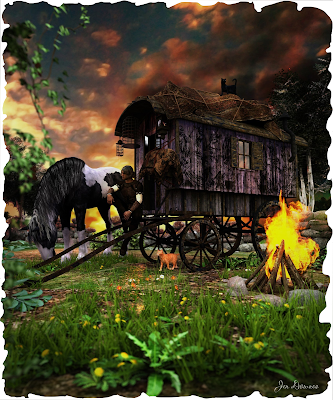
-- view this one full sized, and you'll see that this is the same character as the warrior on the cover. Call him Orel (at this point; the name might change later, along with the story title, though I doubt it for reasons that will shortly become clear). This is where the story begins: the reluctant hero, a man trying to outrun his own reputation ... thrice decorated by the Queen of Zarabia after extraordinary feats in battle. But those feats came at a dreadful price. Orel doesn't sleep, he dreams ... he feels possessed by the spirits of the warriors he's killed in the service of the Queen. She's old, and she dotes on him; she's like his grandmother, which is saying a lot. Orel is not native to this country. He's from the east, and arrived as an orphan boy just old enough to walk. He knew only his name. In the common tongue of  Vennia, Orel means eagle. Queen Isabeau gives him his ticket of leave from the regiment and a heavy purse, so  Orel can take his cats and his horses, take to the backroads in a Vardo like those belonging to his own people ... and find himself, get his heart and mind back into synch. But --


-- yep, it was always on the cards. He hasn't been on the road more than five or six months -- just long enough to watch springtime turn to autumn, and start to feel like a human being again (not because he's sleeping better or not dreaming, but because he and his ghosts have made their peace) -- when he runs into a couple of old comrades from the regiment. Gianna and Lynos have just left the service, and have taken soldiering work in the pay of a local thane, who advertised that he wanted border scouts. This was what they signed up for, but Count Radriq double-talked them with a binding contract ... they didn't read the fine print. Now, rather than just scouting up the source of trouble on the borderlands between Zarabia and neighbouring Kedd, Orel's old army mates are expected to root out the trouble. Since it's big trouble and they're massively outnumbered, they're up against a rather nasty wall. If they renege on the contract, they'll never get this work again, and it's all they're trained for. They're stuck, like flies in amber. So, when they meet Orel by chance, obviously they're recruiting. Or at the very least begging for help. The problem is this dude:


His name is Jevenni and he's baaaad. This Keddish warlord is building himself a rogue empire, and the bricks of its foundations are piracy, highway robbery, pillage, people-trafficking, whatever it takes. He has no scruples, and in this last twelve months has become the bane of the local thane's life. Count Radriq wants the Keddish land pirates gone, and he's holding Gianna and Lynos to the letter of a contract they signed too fast, in ignorance. Enter Orel. Help! So...


...they talk him into it, naturally enough. He's not the type to abandon friends in need. There's a couple of things he suggests: they must hire a good lawyer from Queen Isabeau's own staff, get him here, and have him reduce Count Radriq and his documentation to legal confetti. A lawyer from the capital will cost a great deal of money, but Gianna and Lynos know just where to get it. Jevenni has stolen wagonloads of valuables from the nobles of Count Radriq's fiefdom, and generous rewards have been posted. If they can recover even a tenth of what the warlord has taken, a lawyer from the city of Enashla will settle Radriq. Now...


 ...we launch into several episodic misadventures which are the meat-and-potatoes of true quest-fic, and it all leads eventually, inevitably, to this place: the land pirates' stronghold, in the ancient, ruined city of Ul-kedd-innu. To the horizon, the dead city lies smashed as a result of war, earthquake and plague more than a century in the past. Now, it is bleached bones and granite slabs. Jevenni has carved out his citadel in what used to be the palace and fortress, on the highest point, overlooking the fields of rubble-strewn desolation. According to everything his men divulge -- when captured and made drunk as lords -- he's so complacent, he doesn't post guards. In fact, it's a point of honour that he refuses to post guards: sentries and troops would only acknowledge that he is vulnerable in the heart of his own domain -- Jevenni would deny this to the death. With this information, Orel, the much-decorated veteran, favourite of the Her Serene Majesty, browbeats Count Radriq into providing a detachment from his household cavalry. But the force will hold back in the forest, waiting for a signal and letting the three specialists go in by stealth ... on the understanding that one man can pass where an army couldn't, and a specialist in creating havoc might bring the whole edifice tumbling down before the enemy knew it was happening. Under cover of darkness, in we go --


...long story short: subterfuge, stealth, swordfights and a liberal dash of strange sorcery, and by morning, the land pirates have scattered like roaches. Jevenni is extremely dead, and dawn finds Orel on the crenelated roof of the old fortress, right above the warlord's lair. Under the free, open sky, he is once again making peace with his ghosts and his father's old gods. The eagle -- for this is his name -- is trying very hard indeed to fly high and free, but will his flight carry him away from trouble, or right to the next battlefield? No one knows. Both Gianna and Lynos are injured, though not badly. They sent up the signal flare; the count's cavalry came in fast to scour the ruins for prisoners, and now Gianna and Lynos are only looking for the warlord's cache. They find it -- but in any case, they have actually fulfilled the contract. They no longer need a lawyer from Enashla. They take a portion of the spoils for themselves, as is only fair, and for himself, Orel takes enough to buy him the time, peace and quiet to begin again...


...and the story ends with a full-circle moment, right back where it began. At dawn, Orel hitches up his horses, stocks the Vardo, and is on the road again, headed away from anything remotely like a battlefield. In his ears, the ghosts' thin voices continue to whisper, but he has made his peace with some of them, and believes the others can be persuaded in time. The new sun is warm on his face, the open sky and moors lie ahead in the west, with snow-crowned mountains ringing a horizon so vast, it looks like the whole world. Now, perhaps the eagle can fly free after all. 

ooOOooOOooOOoo

So ends this basic plot. In the writing, the details will change; names will change; a map will be sorted out, and the episodic parts will be tied down into a tight-knit structure. But this is more than enough to get my muse quite excited, and I think I'll enjoy writing this one. The art is not new. These are all 2019-2021 renders, featuring G8 Dae as Orel, G8 Rex as Lynos ... and I can't remember the G8 Female character who appears as Gianna, but she's in the DAZ library somewhere. That's the good old Millennium Horse, plus the DAZ Cat, many, many foliage and furniture props, and the old Gypsy Wagon from Renderosity. Everything here was rendered in Iray; a couple were painted comprehensively in Photoshop afterward. I was messing about with images and ended up, by chance, with these open in Irfanvew, in sequence ... the story just popped out at me! 

Sunday, December 17, 2023

An excellent story comes together through a sequence of random images -- thinking with my fingertips


A courier arrives on a fast horse -- he's ridden for days in a time of direst emergency, and arrives in the Kingdom of Altheon to seek the aid of a great warrior, the one one who could undertake a quest of incredible danger...
 

Jirrel is no longer young. He's gown old on the war trails, and had returned to his homeland with the intention of remaining there for the rest of his life in quiet -- and in peace, where he might seek the salvation of a soul that's worn and bruised after seeing and suffering far too much. But the emergency is too dire, and ...

...knowing he can't face this one alone, he first journeys into the wild highlands of Calhanna, where is recruits his old friend, old comrade, to ride the trail with him. Bremmer is younger by several summers and hasn't seen so many battles; he's actually keen to undertake the quest, which Jirrel thinks is quite mad. But...

For this one, they'll need horses which have strange and magickal powers. Ordinary horses won't get them there, so Jirrel and Bremmer first head into the forests of Alkwood to ask the assistances of great creatures who have befriended them, and fought with them before. The great stallion, North Wind, agrees to help, for the sake of a friend.


And then it's into the marshes that lie to the west of Altheon and Calhanna and Alkwood. These swamps are not long or wide, but they're infested with the waterfolk, wyrfolk, who prey on travelers and will take the unwary for their food and valuables, their horses -- and their lives...


...and it's not much better once the friends have cut a path through the swamps. From the southwest of the region known as Dirtwater, they follow Desolation Creek, which has always been the fastest way through to their goal. But Desolation is plagued by bandits and cutthroats with wyrd powers, and getting through isn't easy.


Still, perseverance pays off -- and Jirrel and Bremmer at last find themselves on the lakeshore surrounding the city of Longlear. Many people, further east, refuse to believe Longlear even exists, but Jirrel has been there before, and he knows -- or knew -- its old king, from the days of his youth. 


Times have changed, and not for the better. The Kings of Longlear have, for centuries, been great sorcerers, and old King Narhagen was once the greatest of them all. But, like all kings, he has enemies, and one of them has become strong enough to turn his own magic against him, plunge him into a wasting sickness from which he cannot recover on his own --


Yet old Narhagen knows exactly who is behind this. It's his cousin, Rhothgand, who made a bid for the crown of Longlear when they were both young and not even fully trained. Thwarted, Rhothgand vanished north, to pursue his studies elsewhere. Now he's back, infinitely more powerful than he ever was, as dark as a barrel of pitch and, some say, driven insane by his lifelong study of arts too dark for sanity to bear. Jirrel and Bremmer must challenge him, defeat him ... it is the only way back to the light for Longlear. So ... it's into the drear Forest of Marnecht, along uncharted ways fraught with evil as well as danger. But at last -- 
 

They come upon Rhothgand in a place where the forest thins, and the black magician has made his stronghold, surrounded by birds and animals he has turned into fiends. The battle is intense, shocking, vile ... Jirrel and Bremmer are armed with the best charms and magicks the sorcerers of Longlear can provide, but it's barely enough. They do defeat Rhothgand, but...


...save for the intervention of Liliath, neither would have survived. Both are badly wounded when the Lady of Windcrest comes to their aid. She is a witch ... ancient, solitary, powerful, but even she could not have defeated Rhothgand before the warriors weakened him. She finishes off the evil and insane black magician, but it's all she can do to convey the warriors back to Windcrest, to heal.


Windcrest is a place of light, a wooded mountain facing the north and east, where the dawn sun angles through the great crystal arches, and Liliath drinks in the power for her own magicks. It is the force that keeps he ageless while the centuries turn and turn. This mountain is her place; no other foot has trodden there in a generation...


She lives with the forest folk, foxes, badgers, martens, squirrels, all of whom are spirits with whom she is in accord...


...and with rare birds who have the ability to talk, and possess the passed-down memories of the eons of their ancestors, of which human beings know nothing ... 


...and of other creatures of the light and air, which come to Liliath's call to sip the power that flows off the ancient witch like the morning dew.


Windcrest is a place of healing and rest, where the warriors of eons gone by would come to be healed of the wounds of both body and soul...


But even the power of Windcrest is not limitless. It has its sunset, just as it has its dawn ... its power fades with the encroaching night ... and before the dawn, when the night is darkest, Bremmer succumbs to wounds that Liliath could not mend. 


It seems the very woodland mourns as Liliath and Jirrel set his funeral pyre. Bremmer had still been young enough to be impulsive -- quick to strike where Jirrel was older, wiser, more cautious. And now, it is the old warrior, sad and tired, who will take his friend's ashes back to the wild highlands of Calhanna, there to be scattered on the morning wind.

Duty done, Jirrel sits on a crag, remembering, and listening to Bremmer's voice in the wind which whips forever over the heaths and mountains of his homeland.

Tuesday, January 25, 2022

Essay: A Milestone


There's a first time for everything, and although I've been published several times, and also at professional level, appearing in a very major magazine with full-on distribution is -- to me! -- an achievement, and a thrill. The contributor's copies of ANALOG Jan/Feb 2022 arrived yesterday, and how sweet it was to have it in my hand and chart this moment. The first step on a road which, I hope, will lead eventually to me marking a day, when I'm cradling a novel in both hands and making another milestone!

I did report the date when ANALOG accepted the story (before the launch of this blog, so it was marked on my personal blog, here on Dec 20, 2020); and  also posted my news when the issue was released a couple of weeks ago (here) -- but this is quite different. Actually having the magazine in my hands makes it ... real. 

It's also an inspiration to me, to be creative, keep driving forward. I do have stories to tell, and if one is completely honest, it can be a lot of fun telling them. I'd also like to write about writing, and in coming weeks and months I'll indulge myself here; but not at the moment when, after an absence of months, the muse has finally deigned to whisper into my ear. I'm hoping to complete a third story in as many weeks.

Updating this a little while later -- let's call that four stories in four weeks, and am about to start another! Eden Can Wait worked out well, though it came in at about twice the length I'd hoped for (about 10k, which will certainly make it harder to sell). However, A Marriage of Inconvenience came in at 3.5k, as did Dust Gets in Your Eyes, and from what I've come to understand about short story writing, this is close to the perfect length ... at least as far as editors understand it! 

Writers might have a different view. For myself, I find it very much more difficult writing a coherent short story than writing a novel. This might sound odd, given that there's twenty times more work (no exaggeration) in a novel than in a short story, but trying to cut a story to fit into a 2,000 - 10,000 word window is ... agony. It's pure torture, which simply means I'm not a natural short story writer. Right. 

Still, one perseveres -- and its also true that some story ideas will actually fall apart if they're treated at greater length. In fact, the story I'm about to write this afternoon is one of these ... so, time to get busy!

Thursday, January 13, 2022

North Wind (Thinking through my fingertips)


Not quite a resolution, but I've made the decision to not let really neat ideas just escape. When something springs to mind that has potential, I'll write the story flash-fashion, if nothing else, and come back to it later, perhaps years later. I've lost hundreds of ideas which were filled with potential, so let's stop that! Here we go...

North Wind 
(Thinking through my fingertips)

In Feynafell, high in the Alcaus Mountains, where barren foothills fall away into mist and great peaks loom like the pavilions of a regiment of wargods on the horizon, the story of Bragutai is still told. His name means North Wind, and his bloodline can be traced through many generations of the royal house’s greatest racers  —  but the claims he was bred in the king’s stable are false.

Bragutai was wild born, in the years when Eldric, Prince of the Feyn, still tried in vain to grow a man’s beard — when his sister, Zamarah, grew taller, shot straighter, swung an axe truer than their father’s favourite. It was Zamarah, not Eldric, who found Bragutai, no more than a bundle of bony legs, shivering beside his mother’s body when snows returned, far too late in the season … Zamarah who carried him home, fed him with her own hands, nurtured him, until he grew taller, stronger than the sires of the king’s best racers.

Save for custom, she would have ridden him to war, but the traditions of a hundred generations of the Feyn forbade girls to bear arms in battle. Many years of war had taught them that young women are the key to the future of any people, and must be shielded, not squandered, at least until their duty to the people is done, and the next generation half-grown to replace them.

So, it fell to Eldric to bear King Andregar’s colours into battle against the seething hoards of the Veru, savage tribes from the west who poured across the hills like tidal waves and offered no quarter. By now a young man, Eldric carried his father’s sword: time had caught up Andregar, leaving the old king trembling in his limbs, wandering in his thoughts, so frail that Princess Zamarah sat in his place upon the Kestrel Throne of the Feyn, and the chieftains took her counsel.

Two things only could Zamarah do for her brother, as he girded on his swords and laced his armour. She gave to him Olnar, the storm witch whose family — for their poverty and debt — were indentured to the Feyn royal house a decade before the boy’s birth. Olnar grew up with the gift of Sight. Wasted in the olive groves and kitchens, he spent his youth at the feet of Feynafell’s greatest mages, mastering every skerrick of magic they could teach while he learned how to command his gift, lest it destroy him as wildfire races through the forest.

And on the eve before battle, Zamarah sent for Eldric, and into his hand placed Bragutai’s halter. She trusted no horse before him. Twice, he saved her life when she was still only a girl — fought and defeated a mountain krall with fangs like scythes, and carried the young princess through a brawling river, when the bridge on the Tane collapsed. No magic or prayer could keep Eldric off the battlefield, for the Veru were starving at winter's end, as always. The instinct for survival spurred them east into gentler, more fecund lands than their own. But if any force could bring Eldric home, Zamarah placed her faith not in her father’s careless gods, who seemed deaf even to the entreaties of their own priests, but in Bragutai.

She watched from the revetment above Feynafell until her people’s battle colours faded from sight. Everything she held most dear marched beneath those banners, and she would receive no word until couriers raced home with news. Only Olnar could send messages, and then merely through the wyrd dreams which haunted Zamarah through the late spring and into the summer…

The winds swung southeast and warmed; spring rain fell as the new year’s crops were seeded; new foals romped and kicked in the paddocks where Andregar’s best stock were bred. She watched Bragutai’s progeny born in those months, while she fretted through the nights, her dreams filled with images of battle, hardship, danger and the longing for home. She might have wondered which dreams were Olnar’s and which were pure fancy, but instinct always told her the truth.

She knew when the Feynafell regiments were routed and sent scrambling for cover among the passes; she saw when fire overtook their supply column, and men went hungry while they cut the dogs loose to hunt for themselves and the horses made do with the high hills’ sparse graze. Zamarah knew when a spearpoint found Olnar’s leg, and he thrashed for days in delirium, wondering if it would be gone when he woke — and she also glimpsed the battle when the Feynaell regiment overrode the Veru, drove them northwest. They fell back, broken for the season just as the caribou returned to their hills and the hunting paths opened.

But Olnar had warned many times, victory would not be won without great cost; the butcher’s bill must be paid. The last battle soon shattered into a desperate scramble for the high ground, and though Eldric’s lieutenants — the chieftains Gareth and Weyland — wrought victory out of chaos, Eldric found himself cut off from the regiment. Wounded, he beat a path through crags and high timber where the Veru and the sickle-fanged krall could smell blood on the air.

Messages of victory sped to Feynafell with regimental couriers, ahead of the wagons bearing the wounded, but the force remained in the north, searching the passes for Eldric. In a week, even Gareth and Weyland gave him up for dead. Only Olnar continued to swear that Eldric lived and was at liberty, though even he could not find the prince in the tangle of rock and heather, where the high hills became the low slopes of the Alcaus Mountains.

In a month, only a token force remained at Trolldance Rocks, and that because Olnar refused to leave. The young witch wrote to Zamarah, swearing on his gods that he could feel Eldric in the wild. Placing her faith in her childhood friend, and with the Veru danger spent now, Zamarah took a party of scouts and lancers and hurried north from Feynafell.

At sunset, when the krall began to wail over the high valleys, they came upon the camp in the wind-shadow of the high granite outcrop known as Trolldance Rocks. Olnar’s wound had healed well enough for him to ride, and at dawn they went out, following his fey instincts … but it was Bragutai who brought Eldric back — both of them wounded, at the end of their strength.

Eldric would recover, with the finest surgeons the old king could provide, but Bragutai’s race was run, and the horse knew it. He had become a legend already, and would never be forgotten — the people of Feynafell tell his story still. Zamarah sang his elegy as he was honoured the way all great horses are: his head, his heart and his hooves were buried deep, where the krall would not find them, among purple heather on a wild hillside not a mile from where he was born.

***

This feels to me as if it would make an excellent YA high fantasy novel, aimed at all people but 65% at girls. I might come back to this, when time permits, and write it.