Showing posts with label Fiction. Show all posts

Friday, April 12, 2024

Fiction: An Eagle's Flight

Yeeeees, there's a story burbling around in my feverish brain. I'm giving it the working title you see right here, An Eagle's Flight, but it could wind up called An Eagle Flies, or Where Eagles Fly, something along those lines. Don't hold me to the title you see here. But --
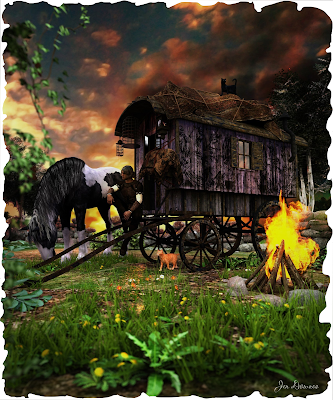

-- view this one full sized, and you'll see that this is the same character as the warrior on the cover. Call him Orel (at this point; the name might change later, along with the story title, though I doubt it for reasons that will shortly become clear). This is where the story begins: the reluctant hero, a man trying to outrun his own reputation ... thrice decorated by the Queen of Zarabia after extraordinary feats in battle. But those feats came at a dreadful price. Orel doesn't sleep, he dreams ... he feels possessed by the spirits of the warriors he's killed in the service of the Queen. She's old, and she dotes on him; she's like his grandmother, which is saying a lot. Orel is not native to this country. He's from the east, and arrived as an orphan boy just old enough to walk. He knew only his name. In the common tongue of  Vennia, Orel means eagle. Queen Isabeau gives him his ticket of leave from the regiment and a heavy purse, so  Orel can take his cats and his horses, take to the backroads in a Vardo like those belonging to his own people ... and find himself, get his heart and mind back into synch. But --


-- yep, it was always on the cards. He hasn't been on the road more than five or six months -- just long enough to watch springtime turn to autumn, and start to feel like a human being again (not because he's sleeping better or not dreaming, but because he and his ghosts have made their peace) -- when he runs into a couple of old comrades from the regiment. Gianna and Lynos have just left the service, and have taken soldiering work in the pay of a local thane, who advertised that he wanted border scouts. This was what they signed up for, but Count Radriq double-talked them with a binding contract ... they didn't read the fine print. Now, rather than just scouting up the source of trouble on the borderlands between Zarabia and neighbouring Kedd, Orel's old army mates are expected to root out the trouble. Since it's big trouble and they're massively outnumbered, they're up against a rather nasty wall. If they renege on the contract, they'll never get this work again, and it's all they're trained for. They're stuck, like flies in amber. So, when they meet Orel by chance, obviously they're recruiting. Or at the very least begging for help. The problem is this dude:


His name is Jevenni and he's baaaad. This Keddish warlord is building himself a rogue empire, and the bricks of its foundations are piracy, highway robbery, pillage, people-trafficking, whatever it takes. He has no scruples, and in this last twelve months has become the bane of the local thane's life. Count Radriq wants the Keddish land pirates gone, and he's holding Gianna and Lynos to the letter of a contract they signed too fast, in ignorance. Enter Orel. Help! So...


...they talk him into it, naturally enough. He's not the type to abandon friends in need. There's a couple of things he suggests: they must hire a good lawyer from Queen Isabeau's own staff, get him here, and have him reduce Count Radriq and his documentation to legal confetti. A lawyer from the capital will cost a great deal of money, but Gianna and Lynos know just where to get it. Jevenni has stolen wagonloads of valuables from the nobles of Count Radriq's fiefdom, and generous rewards have been posted. If they can recover even a tenth of what the warlord has taken, a lawyer from the city of Enashla will settle Radriq. Now...


 ...we launch into several episodic misadventures which are the meat-and-potatoes of true quest-fic, and it all leads eventually, inevitably, to this place: the land pirates' stronghold, in the ancient, ruined city of Ul-kedd-innu. To the horizon, the dead city lies smashed as a result of war, earthquake and plague more than a century in the past. Now, it is bleached bones and granite slabs. Jevenni has carved out his citadel in what used to be the palace and fortress, on the highest point, overlooking the fields of rubble-strewn desolation. According to everything his men divulge -- when captured and made drunk as lords -- he's so complacent, he doesn't post guards. In fact, it's a point of honour that he refuses to post guards: sentries and troops would only acknowledge that he is vulnerable in the heart of his own domain -- Jevenni would deny this to the death. With this information, Orel, the much-decorated veteran, favourite of the Her Serene Majesty, browbeats Count Radriq into providing a detachment from his household cavalry. But the force will hold back in the forest, waiting for a signal and letting the three specialists go in by stealth ... on the understanding that one man can pass where an army couldn't, and a specialist in creating havoc might bring the whole edifice tumbling down before the enemy knew it was happening. Under cover of darkness, in we go --


...long story short: subterfuge, stealth, swordfights and a liberal dash of strange sorcery, and by morning, the land pirates have scattered like roaches. Jevenni is extremely dead, and dawn finds Orel on the crenelated roof of the old fortress, right above the warlord's lair. Under the free, open sky, he is once again making peace with his ghosts and his father's old gods. The eagle -- for this is his name -- is trying very hard indeed to fly high and free, but will his flight carry him away from trouble, or right to the next battlefield? No one knows. Both Gianna and Lynos are injured, though not badly. They sent up the signal flare; the count's cavalry came in fast to scour the ruins for prisoners, and now Gianna and Lynos are only looking for the warlord's cache. They find it -- but in any case, they have actually fulfilled the contract. They no longer need a lawyer from Enashla. They take a portion of the spoils for themselves, as is only fair, and for himself, Orel takes enough to buy him the time, peace and quiet to begin again...


...and the story ends with a full-circle moment, right back where it began. At dawn, Orel hitches up his horses, stocks the Vardo, and is on the road again, headed away from anything remotely like a battlefield. In his ears, the ghosts' thin voices continue to whisper, but he has made his peace with some of them, and believes the others can be persuaded in time. The new sun is warm on his face, the open sky and moors lie ahead in the west, with snow-crowned mountains ringing a horizon so vast, it looks like the whole world. Now, perhaps the eagle can fly free after all. 

ooOOooOOooOOoo

So ends this basic plot. In the writing, the details will change; names will change; a map will be sorted out, and the episodic parts will be tied down into a tight-knit structure. But this is more than enough to get my muse quite excited, and I think I'll enjoy writing this one. The art is not new. These are all 2019-2021 renders, featuring G8 Dae as Orel, G8 Rex as Lynos ... and I can't remember the G8 Female character who appears as Gianna, but she's in the DAZ library somewhere. That's the good old Millennium Horse, plus the DAZ Cat, many, many foliage and furniture props, and the old Gypsy Wagon from Renderosity. Everything here was rendered in Iray; a couple were painted comprehensively in Photoshop afterward. I was messing about with images and ended up, by chance, with these open in Irfanvew, in sequence ... the story just popped out at me! 

Saturday, December 23, 2023

Merry Christmas, 2023


Merry Christmas

to all,

Christmas Eve 2003


From, our house to yours ...

Hoping for a wonderful 2024, and --

Peace on Earth


"...and then I dropped my cup of tea, because something magical happened that hasn’t since I was a child, no older than Tommy is now. The living room faded away. Every light shone brighter, and snow began to fall gently, silently, around the tree. I’d promised him, if he was very quiet and still, and watched, and watched, it could happen — a ruse, to get Tommy to take a nap on Christmas Eve, while mom snatched an hour of rest where she could. He’d fallen asleep — always the plan … and I hadn’t believed in magic in so many years." 

Sunday, December 17, 2023

An excellent story comes together through a sequence of random images -- thinking with my fingertips


A courier arrives on a fast horse -- he's ridden for days in a time of direst emergency, and arrives in the Kingdom of Altheon to seek the aid of a great warrior, the one one who could undertake a quest of incredible danger...
 

Jirrel is no longer young. He's gown old on the war trails, and had returned to his homeland with the intention of remaining there for the rest of his life in quiet -- and in peace, where he might seek the salvation of a soul that's worn and bruised after seeing and suffering far too much. But the emergency is too dire, and ...

...knowing he can't face this one alone, he first journeys into the wild highlands of Calhanna, where is recruits his old friend, old comrade, to ride the trail with him. Bremmer is younger by several summers and hasn't seen so many battles; he's actually keen to undertake the quest, which Jirrel thinks is quite mad. But...

For this one, they'll need horses which have strange and magickal powers. Ordinary horses won't get them there, so Jirrel and Bremmer first head into the forests of Alkwood to ask the assistances of great creatures who have befriended them, and fought with them before. The great stallion, North Wind, agrees to help, for the sake of a friend.


And then it's into the marshes that lie to the west of Altheon and Calhanna and Alkwood. These swamps are not long or wide, but they're infested with the waterfolk, wyrfolk, who prey on travelers and will take the unwary for their food and valuables, their horses -- and their lives...


...and it's not much better once the friends have cut a path through the swamps. From the southwest of the region known as Dirtwater, they follow Desolation Creek, which has always been the fastest way through to their goal. But Desolation is plagued by bandits and cutthroats with wyrd powers, and getting through isn't easy.


Still, perseverance pays off -- and Jirrel and Bremmer at last find themselves on the lakeshore surrounding the city of Longlear. Many people, further east, refuse to believe Longlear even exists, but Jirrel has been there before, and he knows -- or knew -- its old king, from the days of his youth. 


Times have changed, and not for the better. The Kings of Longlear have, for centuries, been great sorcerers, and old King Narhagen was once the greatest of them all. But, like all kings, he has enemies, and one of them has become strong enough to turn his own magic against him, plunge him into a wasting sickness from which he cannot recover on his own --


Yet old Narhagen knows exactly who is behind this. It's his cousin, Rhothgand, who made a bid for the crown of Longlear when they were both young and not even fully trained. Thwarted, Rhothgand vanished north, to pursue his studies elsewhere. Now he's back, infinitely more powerful than he ever was, as dark as a barrel of pitch and, some say, driven insane by his lifelong study of arts too dark for sanity to bear. Jirrel and Bremmer must challenge him, defeat him ... it is the only way back to the light for Longlear. So ... it's into the drear Forest of Marnecht, along uncharted ways fraught with evil as well as danger. But at last -- 
 

They come upon Rhothgand in a place where the forest thins, and the black magician has made his stronghold, surrounded by birds and animals he has turned into fiends. The battle is intense, shocking, vile ... Jirrel and Bremmer are armed with the best charms and magicks the sorcerers of Longlear can provide, but it's barely enough. They do defeat Rhothgand, but...


...save for the intervention of Liliath, neither would have survived. Both are badly wounded when the Lady of Windcrest comes to their aid. She is a witch ... ancient, solitary, powerful, but even she could not have defeated Rhothgand before the warriors weakened him. She finishes off the evil and insane black magician, but it's all she can do to convey the warriors back to Windcrest, to heal.


Windcrest is a place of light, a wooded mountain facing the north and east, where the dawn sun angles through the great crystal arches, and Liliath drinks in the power for her own magicks. It is the force that keeps he ageless while the centuries turn and turn. This mountain is her place; no other foot has trodden there in a generation...


She lives with the forest folk, foxes, badgers, martens, squirrels, all of whom are spirits with whom she is in accord...


...and with rare birds who have the ability to talk, and possess the passed-down memories of the eons of their ancestors, of which human beings know nothing ... 


...and of other creatures of the light and air, which come to Liliath's call to sip the power that flows off the ancient witch like the morning dew.


Windcrest is a place of healing and rest, where the warriors of eons gone by would come to be healed of the wounds of both body and soul...


But even the power of Windcrest is not limitless. It has its sunset, just as it has its dawn ... its power fades with the encroaching night ... and before the dawn, when the night is darkest, Bremmer succumbs to wounds that Liliath could not mend. 


It seems the very woodland mourns as Liliath and Jirrel set his funeral pyre. Bremmer had still been young enough to be impulsive -- quick to strike where Jirrel was older, wiser, more cautious. And now, it is the old warrior, sad and tired, who will take his friend's ashes back to the wild highlands of Calhanna, there to be scattered on the morning wind.

Duty done, Jirrel sits on a crag, remembering, and listening to Bremmer's voice in the wind which whips forever over the heaths and mountains of his homeland.

Friday, April 28, 2023

The Gate to Elsewhere


Edgar had heard many times about the gateway -- and according to the locals who lived around Eltenham Forest, several opened into the earth, or into faraway places. He'd always dreamed of finding one, and last summer holiday he spent most of the time investigating old trees and misty dells, with no luck at all. This year, when he'd given up and wasn't even looking anymore, here it was! Maybe the magic worked this way he thought as he ventured closer, and closer ... the harder you looked, the less you were likely to find yourself a gateway to adventure.

Very close now, he could smell the clean, sharp scents of mountain air and hear the calls of strange birds, unlike any that lived anywhere near Eltenham. A chill breeze wafted from the gate, and tendrils of mist crept cautiously through at his feet. Here at Cricklewood Hall, it was a hot afternoon full of droning beetles and the heavy scent of flowers. But far on the other side of the gate, dawn light cascaded down the east side of a range of dragon-fang mountains, and the smell of pine trees prickled his nose.

He was almost at the gate, dying to step through, when he saw the man on the other side -- and the man has seen him!

Sunday, April 23, 2023

The Festival of Fire ... thinking with my fingertips


Art by Jen Downes
It must begin with a magical city … because all unforgettable fantasies begin with magic, and as for the city — New York or Paris or London, places of culture and learning, where the past brushes shoulders with the dawning world of the future, in a time where all is still possible. Steam locomotives chug by on polished rails, and helium airships glide silently overhead … massive brass telescopes gaze into the cosmos, and diving bells explore the depths of the ocean. Tomorrow beckons brightly, while Yesterday looms like a shadow, dreadful with memories of the war, which almost destroyed everything.

But this isn’t any city. This is Lorentia, the very place where the armistice was negotiated in the days of your great-grandfather’s grandfather. The felix — descended from the superior race, older than humankind, older even then the dragonae, and infinitely wiser than both — negotiated the peace and still oversee it. Some places in this world belong to humans, and dragons may not fly there; other places are the realms of dragonae, and humans beware. The two races maintain a healthy distrust of each other, and a grudging respect.

And once a year the three species, humans, dragonae and the felix come together in the city of Lorentia for the Fire Festival, a remembrance of the great dead on both sides, and a celebration of the courage it took to make peace. On this one night, the dragonae come in to Lorentia. They come in peace, to fly and flame, while humans photograph, paint, record, converse … and some lucky ones fly with the massive old dragons who were there in the war years, and who survived.

The Fire Festival is the high point of the year for all, and every child longs to attend. But until they’re ten years old, children are banished. Dragons are vastly old, very large and they remain wild. Their intelligence is keen, their knowledge of the language of men is deep, but they have no interest in civilization. They treasure their wild life, beyond the mountains, and they’re not about to change.

Tomas Gaffney is eight years old, and obsessed with the dragonae. His ancestor fought in the war; the family home is decorated with relics and images … a painting of the airship from which his grandmother Alexandrina abseiled with the iron harpoons, which was the way of the hunting, in the latter days of the war. There are dragonbone antiques, dragonfang scrimshaw, crossed harpoons over the family’s crest on Alexandrina’s warshield…

All of which has filled Tomas’s young head with a desperate need to attend the Festival of Fire … not two years from now, when he’ll be positively ancient. Now, this year! The festival is just three days away, when he hatches a plot with his best friend, Margarette. She has an aunt who lives in Lorentia. Aunt Rosa will let them stay, if they can only get there. Rosa won’t send them away, because she did the same thing when she was a child, and attended the festival when she was eight!

The two hatch plots and pack bags. They’ll meet in the city, where the Ten Dragon Bridge crosses the river, and they’ll make their way to Rosa’s house. It’s all decided. Tomas makes it away from their village in the early twilight, under a full harvest moon … he doesn’t know Margaretta gets caught before she can slip out of the house. Her father grabs her by the scruff of her raincoat and hauls her back in …

Which means Tomas has no one to meet at the bridge, and no idea where Rosa lives. He arrives in the city alone — and lost. He waits for Margaretta for hours, but she doesn’t arrive, and he guesses what happened. Now it’s late, getting really dark. The lanterns are lit, people throng to the fairgrounds and the marketplaces, where the festival will be celebrated. As a child, he’s not supposed to be here, and as an outsider, he has no idea who he can ask for help.

He thinks about heading for home, but it’s too late. It’s so dark now, and the way back leads through woods and wilds that are dangerous at night. Wolves, vagabonds and highwaymen menace the open road as soon as the sun sets. Tomas has no choice but to brave the city till dawn.

He’s hungry, but he has no money, and if he asks the City Guard to help, he’ll be in all kinds of trouble. They’ll lock him up overnight, so he won’t even see the festival, and they’ll send for his father in the morning. Tomas can expect to be grounded for a hundred years, and do twice the study and three times the chores, to make up for this foolishness. Since he’s going to pay the price, he decides to at least see the festival first. But it’s dangerous in the city … and the danger is not just the dragonae.

All his life, Tomas has listened to whispers about “them city folks,” who can’t be trusted. They’ll rob you blind and leave you for dead — so the neighbours say, and Tomas’s father agreed with them. So he’s distrustful of every face that turns toward him, and when someone tries to speak to him ... “Here, you, kid, you shouldn’t be out on your own!” ... he takes to his heels and runs, losing himself in the crush of people headed to the fairgrounds.

He sees the festival from a distance, at last witnessing the terrible magnificence of the immense old dragons and the playful cuteness of the young … but long past midnight it’s cold and beginning to rain. He’s hungry and tired, and feels threatened by every glance.

Starting to panic, he runs into an alley, huddles against the wall and talks to himself, calling himself all kinds of fool for doing this. He never expected an answer, but when he looks up, it’s one of the felix, with beautiful golden eyes and midnight-black fur, soft paws and an even softer voice.

The young cat can guess Tomas’s problem … this happens every year, and sometimes foolish children do get themselves into all kinds of trouble. This cat is called Tyree, and though he doesn’t have to help Tomas, he has nothing better to do tonight, now the dragons have gone up to Mount Garam to the Council of Elders. There’ll be no more fireworks and flying till next festival, but if this human boy needs to find his friend’s aunt, well, let’s see what the felix can do about that.

He takes Tomas to his grandmother, the venerable and beautiful Zalana, who holds court where the lanterns nod in the night wind and the scent of the river rises, strong and salty, up the steep old streets. Zalana first takes Tomas to shelter — a veranda belonging to a café that’s closed now, out of the wind and rain. She petitions the little daughter of a baker across the lane, who tosses a couple of the day’s leftover chocolate muffins out to Tomas, for his supper. Then Tomas takes a nap, while the felix pass the word among their kind … where does a lady called Rosa live?

All Tomas knows is what Margaretta told him: her aunt lives beside one of the marketplaces, where she smells the eel pies baking before dawn, and haggles with the cheesemonger on her own doorstep, as he goes by to his shop, laden with great wheels of red cheese. Tomas eats his supper, and is too tired to worry much before he slips into dreams full of dragons and fabulous cats…

It’s dawn twilight when Tyree wakes him. The felix think they've discovered Rosa’s house: there’s a bakery opposite, a cheesemonger next door, right beside the marketplace where the best eels are sold, and the name painted on the letterbox is “R.M.I Visconti.” R for Rosa. Is Visconti the last name of Margaretta’s aunt? Tomas doesn’t know, but he follows Tyree across the city … over the bridge, through alleyways and tiny streets, where the two are swept up in adventures, with daring escapes

They dodge a big and bad-tempered constable from the City Guard, and Tomas is certain he’s become a desperate fugitive from the law. They flee from an innkeeper who thinks they’re up to no good, and about to steal the milk bottles off her doorstep. And, skidding around a corner to escape a laundryman carrying a huge wicker hamper — he looks exactly like a pirate, out kidnap a young boy and a young felix and hold them to ransom — they run face-first into a dragonling called Shimui.  

Shimui is still growing into her wings, and is waiting for her mother to give her a ride home beyond the mountains. While they get their breath back, Tomas and Tyree listen to the dragonling’s stories of her home. Her mother is the biggest of the dragons, Shimandara, whom Tomas saw at the fairground the night before. Shimandara thrilled the crowd with displays like fireworks, before flying off to the roost atop Mount Garam, where she and the dragonae elders sat in council with the human elders till dawn.

Both Tomas and Tyree would dearly love to cross the mountains and see the homeland of the dragonae, but it’s still forbidden. Perhaps things might change in the future, if the felix can negotiate a festival in which humans travel north to the Land of Fire, just as the dragonae come to Lorentia for this festival. They’ve been trying to strike a deal, and Tyree hopes it will happen ... but Shimandara’s people are still wary. The biggest, oldest dragons still remember the airships, the hunters, the harpoons. The peace between humans and dragonae is still fragile.

Shimui hears her people calling, and flaps off to join them. Tomas watches wistfully as the young dragon vanishes into the clouds on the shoulder of Mount Garam. Hurrying on, he and Tyree soon find themselves at Rosa’s backdoor … it creaks open … but who should be standing there but Tomas’s father.

In fact, Margaretta told him everything, and Tomas’s dad knew they’d intended to make for Rosa’s house. This would be Tomas’s plan, if only he knew where the lady lived! Tomas’s father is Sebastian Gaffney. He's just as proud of the family heritage as Tomas is, just as enchanted by dragons, and very understanding.

Which is not to say Tomas won’t have to do the study and the chores to make up for this foolishness. He knows now, the city is no place for children to be running around alone, especially at “fire time,” when all manner of rogues come in to “do business” along the river. Sebastian spent the whole night searching for Tomas, but the first hint of him came from a felix called Ninoushka, who’d heard the story of a lost boy from another felix, and another, back along all the alleyways to Grandmother Zalana’s court.

Aunt Rosa just cackles in amusement, remembering when she did this herself. A lot of children do! And after breakfast, Tomas and his father set off for the village, in the family’s pony cart. Tyree rides up on the pony’s shoulder to the edge of the city and then turns for home, while Tomas shouts an invitation to come to the village and visit.

Tired, relieved, not unhappy and resigned to the extra lessons and chores, Tomas leans over the back of the art, watching the city disappear behind, and breathing in the strange, sharp smell on the morning air that to him will always mean dragons


Friday, April 21, 2023

Enigmata ... "The Shortest Story Ever Told"


Enigmata

A princess from out of the aether ―
Not Martian, Venusian, no, neither 
Landed, hapless, on Earth
Where she promptly gave birth
To offspring that could have been either,
            But 
From the heavens there issued a roar,
So loud, metalheads shrieked, "Please, no more!"
While Her Highness's child
Merely giggled and smiled
(Though he threw his stewed prunes on the floor)
            Because 
This princess had pushed the wrong toggle,
In a mishap that makes the mind boggle 
Came, in error, to Earth,
Quite compelled to give birth...
(Yes. Geneticists do curse and goggle.)
            Then 
Down from the Vaults of Forever,
In maelstroms of Physics, soooo clever,
The Great Roar (with vast joy)
Beamed up princess and boy,
And, when asked, replied, "We'll return ... never!"
            Yet 
Indeed, to this day (this part's great)
There's a cult with a somewhat strange trait:
They worship loud noise,
Adore odd-looking boys...
But they're doomed to a rather long wait!

Friday, February 4, 2022

In the Company of Ghosts


Foolish, I suppose, to sit among my ghosts, but they’re my ghosts and I cherish them. Woodsmoke loiters on the still evening air, prickling into a hundred memories. Leaves drift softly from sycamore and chestnut, littering the path which wanders among headstones so old, many are worn smooth, relinquishing any hint of who lies beneath.

My bench sits under a skeletal oak. I’ve been still so long, the red squirrel returns, scampering over those anonymous stones and into the branches above me, in search of a last few acorns. The year is winding gently down; one can almost smell winter. The old graveyard will slumber, wrapped in a blanket of snow before long.

Like the squirrel, I came here searching, but he’s luckier. Acorns are plentiful while the stone I sought eluded me, and I must go soon.

October nights fall early and cold -- a chill discovered my toes an hour ago. My squirrel friend rushes home with his hoard and I, stiff after sitting too long with my ghosts, crunch away through drifted leaves.

He’s here somewhere, quite close, I think: the grandfather who showed me the world, taught how it wags, before he left it when I was still a child. My own days are as short as October’s. The end gnaws inside me, never far from my mind. This is my last October, so I wrap myself in it, as if it were a cloak. My squirrel busily plans ahead for spring, while I wind down with the year, settle to sleep like these trees.

The path takes me back to tall iron gates I’d forgotten; it’s been so long since I was here. Lights shine from the little church, and from houses across the way. A sweetness of stewing fruit wafts from one of them, reminding me of the season, and my ghosts creep closer, invited.

Harvest festival and jarring jam; turnip -- not pumpkin, not here, not then! -- lanterns for Halloween; the newsagents’ shop stocked with sharp-smelling fireworks for Bonfire Night; gathering twigs for the hearth on chill, bright afternoons exactly like this one, half a century ago. I recall the sound and feel of muddy boots crunching through russet, gold and amber, while keen winds stirred bare branches against windswept skies promising snow and, so soon, Christmas lights. Fun for the child, magic for me now. October magic.

My search for that one headstone was fruitless but the evening was far from wasted. Odd, how congenial the company of ghosts can be.

The sun is long gone as I walk away. The old town lies placid with evening, the sky clear, dark velvet. A few people, dressed for the cold, too busy to notice me, rush home like the squirrel -- and so must I, though I’m half a world away from home and won’t, can’t, return here.

So I pause, steal a few more moments to inscribe new-old memories into the crannies of my mind: the deepening calm of the fast-expiring year, the softness of trees settling to drowse until spring; a quiet and welcome I hadn’t looked for in this of all places, under the diamond sparkle of October stars.

Thursday, January 27, 2022

Bloodlines

The Pier Hotel and Landseer Building, Milang

In Milang -- a haphazard town drowsing on a lake shore with its feet in the past and an uncertain future ahead -- I met an American who was in South Australia's Lakes District to track down her Scottish ancestors.

One Saturday night in the Pier Hotel I heard the unmistakable accent and turned to see a woman of forty or fifty: tall, strong bodied, with chestnut hair silvering at the temples. She was elbowing for space at a bar dominated by boaties and fishermen. Being already there, I turned sideways to make space and beckoned her in.

“You're American,” I observed.

“Damn, what gave me away?” She forced a chuckle -- she'd heard the line a thousand times. “Also Canadian, Scots and just a little bit Australian.”

“On holiday down here?”

“Looking for family who came over a long time ago.” She offered her hand. “Jo Campbell.”

I shook the hand. “Chris Daley.” I waited till she'd received a Gordon's with Cascade tonic, then led her to the stools under the high-mounted TV. Cricket was streaming from India, where Australia was being walloped in the third test.

“You got family around here?” I wondered after a long swallow of Coopers.

“Somewhere,” she sighed, “but I can't find them.” She hunted through her bag and produced a crisp new copy of an ancient photo of two young men, sepia and soft by the standards of modern photography. I frowned over it as she told me a little.

In 1889 two brothers sat on the side of a hay wagon in the hills near Loch Lomond and looked into the camera lens. Within the year one of them would go to Canada, the other to Australia. The new Canadian, Donald Campbell, found his way to Alberta, married an English girl and sired a tribe. His boy Jamie got work in Oregon in 1912, married an American and stayed to have two daughters and a son. Jo Campbell was born in 1964 and cherished memories of 'Gramps,' a tall man in his nineties who loved to spin stories of lumberjacking in BC as a youth, and in Oregon as a man.

The other brother, Gordon, landed in South Australia at Christmas, 1889. In letters home he said he put his cash into a small property and modest herd. With the Great War raging over Europe, the local Campbells ran beef cattle along the marshy coast between Milang and Clayton; and sometime in the 1920s they seemed to vanish into the ether.

Cattle country on the shore of Lake Alexandrina.

Floods of biblical proportions frequently overwhelm this area. More than likely, Gordon Campbell was ruined in a natural disaster and wound up working on another property not far from the land he had owned.

“You've looked at the parish records?” I asked.

She took a sip of G&T and nodded. “He married a girl called Maggie. No family name was recorded.” Her brow creased. “Is that weird, or did the locals often forget the bride's maiden name in those days?”

“Not as a rule,” I mused. “She might have been indigenous. Maggie probably wouldn't have been her birth name, and it's possible the parson omitted the full name because he couldn't even guess how to spell it.”

“Indigenous?” Jo's eyes widened.

For a split second I wondered if she might take umbrage. You stumble over racism in the least expected places, but these days it's so rare, one tends to speak unguardedly. I needn't have worried.

Blue-green eyes sparkled. “I hadn't thought of that. Gives me another line of inquiry -- and I know just who to talk to.” She finished the drink and hopped off the stool. “You staying in town?”

“At the motel.” I gestured along past the shops and the historic railway exhibit. “I'm doing routine water sampling, so I'll be here a few days.”

Milang Station, end of an extinct line and now a standing exhibit. In winter or early spring it's green.

“I'll catch up with you,” she promised.

And she did. On Tuesday I heard my name called in strident tones as I stepped out of the general store with a tall coffee. “Hey, you came up with something,” I hazarded -- an easy guess, going by the big smiles.

“I talked to a retired priest, old as God, lives halfway to Strathalbyn. Father Pat remembers local Campbells in the '30s and '40s. He says they moved across the lakes before I was born. They live in some place called Raukkan. D'you know it? How d'you get there from here?”

I knew it quite well: a quiet little place on the far shore of Lake Alexandrina, in the Narrung region. “It's quite a drive,” I told her, “but the roads are good and it's pretty country.”

“No bus?” she asked hopefully.

“No bus. What's wrong with your car?”

“On the fritz. I did the rent-a-wreck thing, and I'm regretting it -- don't think I want to to take off for the wilderness in that thing.”

“Not quite the wilderness,” I chuckled, “but...” I glanced at my watch. “What the hell? Grab your bags and kick in twenty for petrol, and we're outta here.”

We were on the road minutes later. She was installed in rooms behind the Landseer building, and ran back for her bag and camera. My Land Cruiser was beat up but utterly reliable, and I pointed it at Langhorne, Wellington and, far off, Narrung, without a qualm.

The Narrung road -- in November, almost summer. Far side of Lake Alexandrina.

Good weather, chicken salad rolls and a lot of Johnny Cash passed the time. It's beautiful country: gentle hills, vast skies, and the further out you get, the better I like it. Peace and quiet settle over the land, giving a tenuous impression of how it might have been before Europeans intruded.

Narrung car ferry.
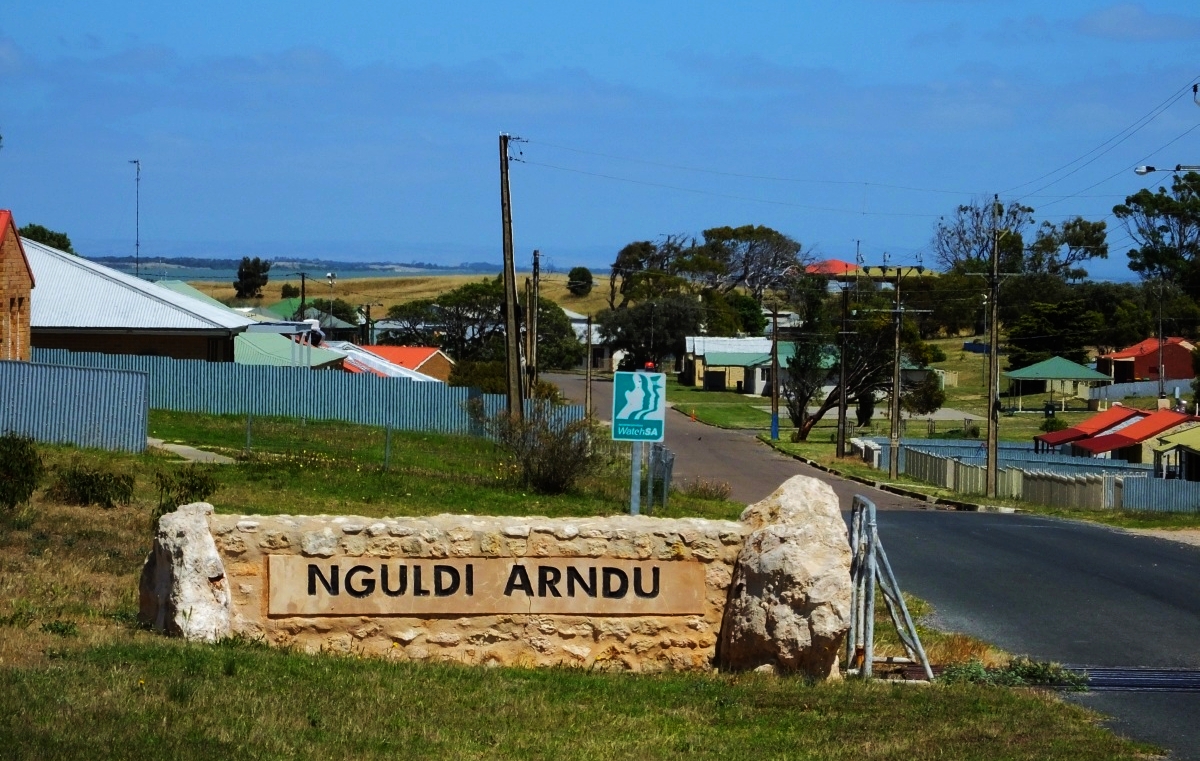
We waited for the Narrung ferry and then, just after noon, I stopped a few meters short of the town boundary. The stone gateway is marked Raukkan on one side, Nguldi Arndu on the other. 

It's an indigenous town: laid back, quiet, isolated, single storey building line, houses sprawled wide because there's elbow room aplenty -- fronting onto the vast blue expanse of the lake.

Jo read the roadside infoboards, shaded her eyes with one hand and wondered, 

 “How would I find a guy called Uncle Ben Campbell?”

Gateway to the town of Raukkan.

“Try the post office,” I suggested. “They'll definitely know where he lives. They won't hand out his address, but they can send a message. If he wants to meet, he'll be here.”

She peered back at the infoboard. “Post office...”

“Straight ahead on your right, past the clinic.” I pointed. “Look, I'll stay in the car. This is a family affair. You're the Campbells, I'm just the transportation.”

I watched her walk on into town and listened to quiet so profound, a warbling magpie seemed unpardonably loud. You don't hear such quiet in any city. I find it as humbling as it's pacifying … for a moment one realizes how infinitesimal humans are, lost in infinities of space we can't even visualize, much less comprehend.

Six assorted kids chased a soccer ball down the street; a crow called from the roof of the sandstone hall with the smart new galvanized roof; a flight of pelicans went gliding between Lakes Albert and Alexandrina, right over my head, white against the blue.

In fifteen minutes Jo jogged back up the road with a cautious smile and the wind in the copper-and-silver hair. “I'm invited to the drop-in centre for tea. Wanna be my 'plus one'?”

“For tea? Sure.” I was parched.

The drop-in centre is right by the old post office, facing the park. The kids were playing footy there now -- Aussie rules with a soccer ball, and a great time being had by all. Kids don't change, the world over; it's adults who write the rules, then break them every chance they get and make trouble. Jo and I settled in a corner of the centre, which was almost deserted at this hour. The chance to get out of the sun was welcome, and no cuppa tastes better than the one you didn't make yourself.

We waited half an hour for Ben Campell, and I held my breath, hoping for Jo's sake. She'd told me a little of her own story, and I knew she was the last of her clan from North America. The name disappeared when the daughters scattered across the globe with their husbands; after the world wars, only her father, another Jamie, remained to perpetuate the name. He passed away, leaving Jo the only surviving Campbell -- the last of her line who identified as Campbell. She'd lost touch with the distant cousins in Ontario, New Zealand, Illinois. One erstwhile Campbell daughter was said to be back in Scotland, but with the name gone and the bloodline diluted, they were difficult to find and seemed reluctant to correspond.

So here were the last actual Campbells descended from the intrepid Gordon and Donald. One was a six-foot, sturdy American; the other stepped in out of the sun, and I crossed my fingers. Ben Campbell was close to full-blood Ngarrindjeri. I stepped back, not wanting to be in the way. Someone at the post office had sent a coherent message, and Raukkan's surviving Campbell was as curious as the one from Portland, Oregon.

He was over eighty, but straight-backed, thin and wiry, with snowy hair and beard -- in bluejeans, sweatshirt, sneakers, the uniform of every generation. Ben studied Jo from under a white bush of brows. Dark eyes took her apart, limb from limb, and put her back together. I guess he recognized a fellow Campbell, because he brought out his wallet and produced an ancient photograph.

“Oh, my,” Jo whispered, and dug though her bag.

The two photos sat side by side on the table between the empty cups. Hers was a recent copy, faithfully reproducing every crease and scratch. His was old, fragile, printed on card, the original sepia, no hint of gloss. The same photo.

They pulled up chairs, sent for more tea and talked. They'd talk for hours, but I stayed just long enough to learn that Gordon married the local girl and fought with the family back home over it. He never had the chance to mention Maggie was Ngarrindjeri -- which could have been an issue a century ago -- because he'd originally promised to wait for his childhood sweetheart to arrive out here … both families back home were too furious to acknowledge another letter. A fire reduced his property to scorched earth in 1916, so he worked on a station between Clayton and Finiss until '24, and retired to Poltaloch, across the lake. His boy, Donald, married a full-blood Ngarrindjeri lass and had one surviving son to carry on the family name.

Benjamin was still alive and well, and living in Raukkan.

Jo and Ben had so much to talk about. They'd both forgotten me,so I wrote my name and number on a postcard and left it with the girl at the counter. If I was needed, they'd call.

With a smile I stepped back into the sun, hands in pockets, contemplating the drive back to Milang in the growing afternoon shadows.

oOoooOoooOo

This is fiction, though it's set in real places and the story is so perfectly possible, I'd actually be surprised if something similar hasn't happened. Maybe a Canadian tracking down Irish ancestors. 

Dave and I went right around Lake Alexandrina on my 2015 "birthday trip" -- that is, an overnight getaway, where we'll stay at the Milang Lakes motel on Saturday night, and be able to go further the next day, before turning for home. 

Here we are parked beside the infoboard described above -- the town gate is just out of frame to the right...


And here's the left-side poster you see in the little shelter there -- a kind of tourist guide to the Narrung and Corrong regions. (The image is uploaded at full size and is perfectly readable.) 

It's a gorgeous part of the world, one of my favorites. If you're interested, there's more about Milang, the Lakes District and so forth, on my old travel blog, Meander to the Max. I'm remembering four or five posts featuring Milang, so -- browse around, you'll find them.

(Dang, I need to do some work on the travel blog. There's about another 50 posts I need to make, without delay. More. Must set aside an hour or two here and there, and see what I can do.) 

Thursday, January 13, 2022

North Wind (Thinking through my fingertips)


Not quite a resolution, but I've made the decision to not let really neat ideas just escape. When something springs to mind that has potential, I'll write the story flash-fashion, if nothing else, and come back to it later, perhaps years later. I've lost hundreds of ideas which were filled with potential, so let's stop that! Here we go...

North Wind 
(Thinking through my fingertips)

In Feynafell, high in the Alcaus Mountains, where barren foothills fall away into mist and great peaks loom like the pavilions of a regiment of wargods on the horizon, the story of Bragutai is still told. His name means North Wind, and his bloodline can be traced through many generations of the royal house’s greatest racers  —  but the claims he was bred in the king’s stable are false.

Bragutai was wild born, in the years when Eldric, Prince of the Feyn, still tried in vain to grow a man’s beard — when his sister, Zamarah, grew taller, shot straighter, swung an axe truer than their father’s favourite. It was Zamarah, not Eldric, who found Bragutai, no more than a bundle of bony legs, shivering beside his mother’s body when snows returned, far too late in the season … Zamarah who carried him home, fed him with her own hands, nurtured him, until he grew taller, stronger than the sires of the king’s best racers.

Save for custom, she would have ridden him to war, but the traditions of a hundred generations of the Feyn forbade girls to bear arms in battle. Many years of war had taught them that young women are the key to the future of any people, and must be shielded, not squandered, at least until their duty to the people is done, and the next generation half-grown to replace them.

So, it fell to Eldric to bear King Andregar’s colours into battle against the seething hoards of the Veru, savage tribes from the west who poured across the hills like tidal waves and offered no quarter. By now a young man, Eldric carried his father’s sword: time had caught up Andregar, leaving the old king trembling in his limbs, wandering in his thoughts, so frail that Princess Zamarah sat in his place upon the Kestrel Throne of the Feyn, and the chieftains took her counsel.

Two things only could Zamarah do for her brother, as he girded on his swords and laced his armour. She gave to him Olnar, the storm witch whose family — for their poverty and debt — were indentured to the Feyn royal house a decade before the boy’s birth. Olnar grew up with the gift of Sight. Wasted in the olive groves and kitchens, he spent his youth at the feet of Feynafell’s greatest mages, mastering every skerrick of magic they could teach while he learned how to command his gift, lest it destroy him as wildfire races through the forest.

And on the eve before battle, Zamarah sent for Eldric, and into his hand placed Bragutai’s halter. She trusted no horse before him. Twice, he saved her life when she was still only a girl — fought and defeated a mountain krall with fangs like scythes, and carried the young princess through a brawling river, when the bridge on the Tane collapsed. No magic or prayer could keep Eldric off the battlefield, for the Veru were starving at winter's end, as always. The instinct for survival spurred them east into gentler, more fecund lands than their own. But if any force could bring Eldric home, Zamarah placed her faith not in her father’s careless gods, who seemed deaf even to the entreaties of their own priests, but in Bragutai.

She watched from the revetment above Feynafell until her people’s battle colours faded from sight. Everything she held most dear marched beneath those banners, and she would receive no word until couriers raced home with news. Only Olnar could send messages, and then merely through the wyrd dreams which haunted Zamarah through the late spring and into the summer…

The winds swung southeast and warmed; spring rain fell as the new year’s crops were seeded; new foals romped and kicked in the paddocks where Andregar’s best stock were bred. She watched Bragutai’s progeny born in those months, while she fretted through the nights, her dreams filled with images of battle, hardship, danger and the longing for home. She might have wondered which dreams were Olnar’s and which were pure fancy, but instinct always told her the truth.

She knew when the Feynafell regiments were routed and sent scrambling for cover among the passes; she saw when fire overtook their supply column, and men went hungry while they cut the dogs loose to hunt for themselves and the horses made do with the high hills’ sparse graze. Zamarah knew when a spearpoint found Olnar’s leg, and he thrashed for days in delirium, wondering if it would be gone when he woke — and she also glimpsed the battle when the Feynaell regiment overrode the Veru, drove them northwest. They fell back, broken for the season just as the caribou returned to their hills and the hunting paths opened.

But Olnar had warned many times, victory would not be won without great cost; the butcher’s bill must be paid. The last battle soon shattered into a desperate scramble for the high ground, and though Eldric’s lieutenants — the chieftains Gareth and Weyland — wrought victory out of chaos, Eldric found himself cut off from the regiment. Wounded, he beat a path through crags and high timber where the Veru and the sickle-fanged krall could smell blood on the air.

Messages of victory sped to Feynafell with regimental couriers, ahead of the wagons bearing the wounded, but the force remained in the north, searching the passes for Eldric. In a week, even Gareth and Weyland gave him up for dead. Only Olnar continued to swear that Eldric lived and was at liberty, though even he could not find the prince in the tangle of rock and heather, where the high hills became the low slopes of the Alcaus Mountains.

In a month, only a token force remained at Trolldance Rocks, and that because Olnar refused to leave. The young witch wrote to Zamarah, swearing on his gods that he could feel Eldric in the wild. Placing her faith in her childhood friend, and with the Veru danger spent now, Zamarah took a party of scouts and lancers and hurried north from Feynafell.

At sunset, when the krall began to wail over the high valleys, they came upon the camp in the wind-shadow of the high granite outcrop known as Trolldance Rocks. Olnar’s wound had healed well enough for him to ride, and at dawn they went out, following his fey instincts … but it was Bragutai who brought Eldric back — both of them wounded, at the end of their strength.

Eldric would recover, with the finest surgeons the old king could provide, but Bragutai’s race was run, and the horse knew it. He had become a legend already, and would never be forgotten — the people of Feynafell tell his story still. Zamarah sang his elegy as he was honoured the way all great horses are: his head, his heart and his hooves were buried deep, where the krall would not find them, among purple heather on a wild hillside not a mile from where he was born.

***

This feels to me as if it would make an excellent YA high fantasy novel, aimed at all people but 65% at girls. I might come back to this, when time permits, and write it.