Tuesday, November 21, 2023

Announcement: A Darkness Incandescent is published in Best of Newmyths Volume 4

'A Darkness Incandescent' has just been released, in the Cosmic Muse anthology, from Newmyths ... it's a poem I'm rather proud of, and it's thrilling to see it in this volume.

The link to buy Cosmic Muse as an ebook is a little awkward -- it's available in so many formats, the publisher has supplied a "catch all" link which will send you to something called "Books 2 Read," and from there, you can bump on to your store of choice, with something like nine options ... though not without allowing Books 2 Read to set "preference" cookies (which, for myself, I prefer not to do. It's your call). 

So I'll give you three links here: this first will take you to the aggregator, Smashwords, where books funnel through to ebook stores galore; the second is to the "Books 2 Read" page, where you can make your own decisions about whether you'll accept cookies; and the third link is to the paperback edition of this anthology, available from Amazon


Thursday, October 19, 2023

Announcement: A Glamour of Toads is out

It's been a long time indeed since I updated this blog ... life has been like that. As the saying goes, "One damn" thing after another.' 

Anyone remember the Farside-style cartoon of two monsters chasing each other down a street while a couple of middle-aged ladies look on, and one lady says to the other (!), "It's just one goddamn thing after another." Mmm. That's been life in a nutshell. Don't ask. 

But I'm back at last -- with less news that I'd hoped to be able to relay, but at least there's something. 

It begins with an update on A Glamour of Toads, which was published in Dragon Gems, Summer 2023 issue ... available as of last month, I believe. As the cover indicates, this is a kind of cute and/or "cracked" fairy-tale fantasy anthology, and I'm sure Glamour fits perfectly...

The story of a young woman who's blessed, or cursed, with enormous courage and physical ugliness (no other way to parse this, so -- grasp it, and weaponize it), and she finds herself born into the era of the witch hunts, what we call the 'burning times.' 

Worse yet, her village lies directly in the path of an oncoming Witchfinder who's notorious for his treatment of people just like her. She's not a witch, but she's going to be treated as one ... so, what's to be done about it? Sarah has recently lost her dad, who was a woodsman by trade. His work often took them into the forest, which is how Sarah knows of a certain cottage, way back in the wildwood: the house where three women live. Women who are so skilled in the Craft of the Wise, the world is oblivious to them. They have no fear of the Witchfinder and his troops, and once upon a moonless midnight, Sarah knocks at their door and begs for a boon. For magic

The only potential fly in the ointment is that to read Glamour, you'll need a subscription to something called SCRIBD.  Now, in and of itself, SRIBD is a marvellous idea. In a nutshell, here is their advertising line: "Enjoy millions of ebooks, audiobooks, magazines, and more, with a free trial." 

You could read Dragon Gems Summer 2023 on the 30-day free trial, course ... but if I had a tablet, and I didn't mind a monthly fee of about AUD$20, I think I'd be subscribing. I'll be brutally honest at this moment: I have things to save for, so my own discretional spending is shackled and bound. But when I've bought the camera and lenses I want (price tag, around two grand -- you get the picture), SRCIBD will be on my list, along with a YouTube subscription (to get rid of those pesky commercials). 

So -- Find A Glamour of Toads right here, but be prepared to take them up on the offer of that free trial. You should be able to read on phones ... I certainly could!

I wish there were more to update, but the publishers for whom a whole raft of stories and poems were written have been delayed, and only recently opened back up for reading. Everything is late, so the news is a bit thin on the publishing front. 

However, there's more, if the hard, demanding and exacting work of the editor counts in this publishing game -- and it does. I spent some fascinating weeks working on A Tradition of Evil, a Sherlock Holmes novel by Mike Adamson. The job was actually a lot of fun, and the book (which went on sale, from Belanger Books, just a couple of months ago) is a great read that's being very well rated at Amazon. It was also my great pleasure to build Mike's new author website, not least because it gave me the opportunity to flex my illustrator's muscles, and provide all the original artwork...

And when I'd finished construction on that website, I was so envious -- I decided to build one for myself,  for my art and photography. I'm halfway through at this moment. And that is how time flew away, even before you add in some bad luck, car troubles, winter, flu, and the usual domestic drivel. Something had to go on the backburner, and the blogs were the unfortunate choice. I've barely kept touch with Facebook in the same span of time! 

Hopefully, this can turn around now.  

Thursday, May 18, 2023

Announcement: Collateral Damage has been podcast by Analog!


News! ANALOG Science Fiction has podcast my story in the May/June issue -- "Collateral Damage." The podcast is online right now, and you can find it here ... happy listening!


(This artwork here is not from the magazine. I've put this together myself, as a "flag-waver," or an "attention grabber," but this *is* the character from "Collateral Damage," as she appears in one of the other stories, which you can find elsewhere. It's an Iray render from late '21, and it fits the story to a T!)

Friday, April 28, 2023

The Gate to Elsewhere


Edgar had heard many times about the gateway -- and according to the locals who lived around Eltenham Forest, several opened into the earth, or into faraway places. He'd always dreamed of finding one, and last summer holiday he spent most of the time investigating old trees and misty dells, with no luck at all. This year, when he'd given up and wasn't even looking anymore, here it was! Maybe the magic worked this way he thought as he ventured closer, and closer ... the harder you looked, the less you were likely to find yourself a gateway to adventure.

Very close now, he could smell the clean, sharp scents of mountain air and hear the calls of strange birds, unlike any that lived anywhere near Eltenham. A chill breeze wafted from the gate, and tendrils of mist crept cautiously through at his feet. Here at Cricklewood Hall, it was a hot afternoon full of droning beetles and the heavy scent of flowers. But far on the other side of the gate, dawn light cascaded down the east side of a range of dragon-fang mountains, and the smell of pine trees prickled his nose.

He was almost at the gate, dying to step through, when he saw the man on the other side -- and the man has seen him!

Sunday, April 23, 2023

The Festival of Fire ... thinking with my fingertips


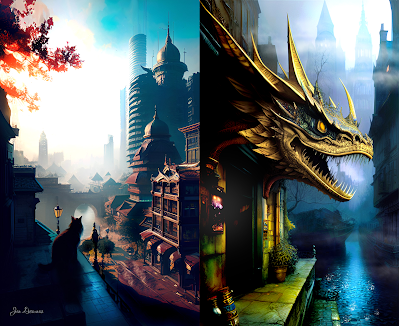
Art by Jen Downes
It must begin with a magical city … because all unforgettable fantasies begin with magic, and as for the city — New York or Paris or London, places of culture and learning, where the past brushes shoulders with the dawning world of the future, in a time where all is still possible. Steam locomotives chug by on polished rails, and helium airships glide silently overhead … massive brass telescopes gaze into the cosmos, and diving bells explore the depths of the ocean. Tomorrow beckons brightly, while Yesterday looms like a shadow, dreadful with memories of the war, which almost destroyed everything.

But this isn’t any city. This is Lorentia, the very place where the armistice was negotiated in the days of your great-grandfather’s grandfather. The felix — descended from the superior race, older than humankind, older even then the dragonae, and infinitely wiser than both — negotiated the peace and still oversee it. Some places in this world belong to humans, and dragons may not fly there; other places are the realms of dragonae, and humans beware. The two races maintain a healthy distrust of each other, and a grudging respect.

And once a year the three species, humans, dragonae and the felix come together in the city of Lorentia for the Fire Festival, a remembrance of the great dead on both sides, and a celebration of the courage it took to make peace. On this one night, the dragonae come in to Lorentia. They come in peace, to fly and flame, while humans photograph, paint, record, converse … and some lucky ones fly with the massive old dragons who were there in the war years, and who survived.

The Fire Festival is the high point of the year for all, and every child longs to attend. But until they’re ten years old, children are banished. Dragons are vastly old, very large and they remain wild. Their intelligence is keen, their knowledge of the language of men is deep, but they have no interest in civilization. They treasure their wild life, beyond the mountains, and they’re not about to change.

Tomas Gaffney is eight years old, and obsessed with the dragonae. His ancestor fought in the war; the family home is decorated with relics and images … a painting of the airship from which his grandmother Alexandrina abseiled with the iron harpoons, which was the way of the hunting, in the latter days of the war. There are dragonbone antiques, dragonfang scrimshaw, crossed harpoons over the family’s crest on Alexandrina’s warshield…

All of which has filled Tomas’s young head with a desperate need to attend the Festival of Fire … not two years from now, when he’ll be positively ancient. Now, this year! The festival is just three days away, when he hatches a plot with his best friend, Margarette. She has an aunt who lives in Lorentia. Aunt Rosa will let them stay, if they can only get there. Rosa won’t send them away, because she did the same thing when she was a child, and attended the festival when she was eight!

The two hatch plots and pack bags. They’ll meet in the city, where the Ten Dragon Bridge crosses the river, and they’ll make their way to Rosa’s house. It’s all decided. Tomas makes it away from their village in the early twilight, under a full harvest moon … he doesn’t know Margaretta gets caught before she can slip out of the house. Her father grabs her by the scruff of her raincoat and hauls her back in …

Which means Tomas has no one to meet at the bridge, and no idea where Rosa lives. He arrives in the city alone — and lost. He waits for Margaretta for hours, but she doesn’t arrive, and he guesses what happened. Now it’s late, getting really dark. The lanterns are lit, people throng to the fairgrounds and the marketplaces, where the festival will be celebrated. As a child, he’s not supposed to be here, and as an outsider, he has no idea who he can ask for help.

He thinks about heading for home, but it’s too late. It’s so dark now, and the way back leads through woods and wilds that are dangerous at night. Wolves, vagabonds and highwaymen menace the open road as soon as the sun sets. Tomas has no choice but to brave the city till dawn.

He’s hungry, but he has no money, and if he asks the City Guard to help, he’ll be in all kinds of trouble. They’ll lock him up overnight, so he won’t even see the festival, and they’ll send for his father in the morning. Tomas can expect to be grounded for a hundred years, and do twice the study and three times the chores, to make up for this foolishness. Since he’s going to pay the price, he decides to at least see the festival first. But it’s dangerous in the city … and the danger is not just the dragonae.

All his life, Tomas has listened to whispers about “them city folks,” who can’t be trusted. They’ll rob you blind and leave you for dead — so the neighbours say, and Tomas’s father agreed with them. So he’s distrustful of every face that turns toward him, and when someone tries to speak to him ... “Here, you, kid, you shouldn’t be out on your own!” ... he takes to his heels and runs, losing himself in the crush of people headed to the fairgrounds.

He sees the festival from a distance, at last witnessing the terrible magnificence of the immense old dragons and the playful cuteness of the young … but long past midnight it’s cold and beginning to rain. He’s hungry and tired, and feels threatened by every glance.

Starting to panic, he runs into an alley, huddles against the wall and talks to himself, calling himself all kinds of fool for doing this. He never expected an answer, but when he looks up, it’s one of the felix, with beautiful golden eyes and midnight-black fur, soft paws and an even softer voice.

The young cat can guess Tomas’s problem … this happens every year, and sometimes foolish children do get themselves into all kinds of trouble. This cat is called Tyree, and though he doesn’t have to help Tomas, he has nothing better to do tonight, now the dragons have gone up to Mount Garam to the Council of Elders. There’ll be no more fireworks and flying till next festival, but if this human boy needs to find his friend’s aunt, well, let’s see what the felix can do about that.

He takes Tomas to his grandmother, the venerable and beautiful Zalana, who holds court where the lanterns nod in the night wind and the scent of the river rises, strong and salty, up the steep old streets. Zalana first takes Tomas to shelter — a veranda belonging to a cafĂ© that’s closed now, out of the wind and rain. She petitions the little daughter of a baker across the lane, who tosses a couple of the day’s leftover chocolate muffins out to Tomas, for his supper. Then Tomas takes a nap, while the felix pass the word among their kind … where does a lady called Rosa live?

All Tomas knows is what Margaretta told him: her aunt lives beside one of the marketplaces, where she smells the eel pies baking before dawn, and haggles with the cheesemonger on her own doorstep, as he goes by to his shop, laden with great wheels of red cheese. Tomas eats his supper, and is too tired to worry much before he slips into dreams full of dragons and fabulous cats…

It’s dawn twilight when Tyree wakes him. The felix think they've discovered Rosa’s house: there’s a bakery opposite, a cheesemonger next door, right beside the marketplace where the best eels are sold, and the name painted on the letterbox is “R.M.I Visconti.” R for Rosa. Is Visconti the last name of Margaretta’s aunt? Tomas doesn’t know, but he follows Tyree across the city … over the bridge, through alleyways and tiny streets, where the two are swept up in adventures, with daring escapes

They dodge a big and bad-tempered constable from the City Guard, and Tomas is certain he’s become a desperate fugitive from the law. They flee from an innkeeper who thinks they’re up to no good, and about to steal the milk bottles off her doorstep. And, skidding around a corner to escape a laundryman carrying a huge wicker hamper — he looks exactly like a pirate, out kidnap a young boy and a young felix and hold them to ransom — they run face-first into a dragonling called Shimui.  

Shimui is still growing into her wings, and is waiting for her mother to give her a ride home beyond the mountains. While they get their breath back, Tomas and Tyree listen to the dragonling’s stories of her home. Her mother is the biggest of the dragons, Shimandara, whom Tomas saw at the fairground the night before. Shimandara thrilled the crowd with displays like fireworks, before flying off to the roost atop Mount Garam, where she and the dragonae elders sat in council with the human elders till dawn.

Both Tomas and Tyree would dearly love to cross the mountains and see the homeland of the dragonae, but it’s still forbidden. Perhaps things might change in the future, if the felix can negotiate a festival in which humans travel north to the Land of Fire, just as the dragonae come to Lorentia for this festival. They’ve been trying to strike a deal, and Tyree hopes it will happen ... but Shimandara’s people are still wary. The biggest, oldest dragons still remember the airships, the hunters, the harpoons. The peace between humans and dragonae is still fragile.

Shimui hears her people calling, and flaps off to join them. Tomas watches wistfully as the young dragon vanishes into the clouds on the shoulder of Mount Garam. Hurrying on, he and Tyree soon find themselves at Rosa’s backdoor … it creaks open … but who should be standing there but Tomas’s father.

In fact, Margaretta told him everything, and Tomas’s dad knew they’d intended to make for Rosa’s house. This would be Tomas’s plan, if only he knew where the lady lived! Tomas’s father is Sebastian Gaffney. He's just as proud of the family heritage as Tomas is, just as enchanted by dragons, and very understanding.

Which is not to say Tomas won’t have to do the study and the chores to make up for this foolishness. He knows now, the city is no place for children to be running around alone, especially at “fire time,” when all manner of rogues come in to “do business” along the river. Sebastian spent the whole night searching for Tomas, but the first hint of him came from a felix called Ninoushka, who’d heard the story of a lost boy from another felix, and another, back along all the alleyways to Grandmother Zalana’s court.

Aunt Rosa just cackles in amusement, remembering when she did this herself. A lot of children do! And after breakfast, Tomas and his father set off for the village, in the family’s pony cart. Tyree rides up on the pony’s shoulder to the edge of the city and then turns for home, while Tomas shouts an invitation to come to the village and visit.

Tired, relieved, not unhappy and resigned to the extra lessons and chores, Tomas leans over the back of the art, watching the city disappear behind, and breathing in the strange, sharp smell on the morning air that to him will always mean dragons


Friday, April 21, 2023

Enigmata ... "The Shortest Story Ever Told"


Enigmata

A princess from out of the aether ―
Not Martian, Venusian, no, neither 
Landed, hapless, on Earth
Where she promptly gave birth
To offspring that could have been either,
            But 
From the heavens there issued a roar,
So loud, metalheads shrieked, "Please, no more!"
While Her Highness's child
Merely giggled and smiled
(Though he threw his stewed prunes on the floor)
            Because 
This princess had pushed the wrong toggle,
In a mishap that makes the mind boggle 
Came, in error, to Earth,
Quite compelled to give birth...
(Yes. Geneticists do curse and goggle.)
            Then 
Down from the Vaults of Forever,
In maelstroms of Physics, soooo clever,
The Great Roar (with vast joy)
Beamed up princess and boy,
And, when asked, replied, "We'll return ... never!"
            Yet 
Indeed, to this day (this part's great)
There's a cult with a somewhat strange trait:
They worship loud noise,
Adore odd-looking boys...
But they're doomed to a rather long wait!

Thursday, April 20, 2023

Poem: Dreams of Spring


Dreams of Spring

The leaves are falling.

The woodland blazes, gold and flame,

More beauteous at the death

Than in those days when

Blossom turned to greet spring's sun

Without a thought of summer,

Much less of fall.

But every breeze steals gold and fire,

And only bones endure beneath...

So brief is autumn: winter snows

Begin to fall before the final leaves,

And those enduring bones --

Strong yet beak, bare, stark --

Merely drowse, and wait, and dream

Of days when blossom crowned their brows

And strewed their feet. They dream, I think,

Of youth and yesteryear.


(Originally published in Sylvia Magazine)


Wednesday, March 8, 2023

Announcement: Collateral Damage -- and A Glamour of Toads!


Good news! A Glamour of Toads has been optioned by Water Dragon Publishing, for their mid-year anthology, Dragon Gems. Look for it around summer, or end-of-summer -- which is winter or early spring down under, of course. "Toads" is a mediaeval fantasy, juuuust a little bit on the dark side, about magic and mortal fear, and a lot more. (The artwork here wasn't actually done for the story, but I'm about to post an announcement to my writing blog, and I thought, "Hey, that almost fits it to a tee, I just need to do a bit of repainting...!") I'll let you know when the anthology is published ... 

Also,  Collateral Damage is in the March issue of ANALOG Science Fiction. If it isn't on the magazine racks now, it soon will be. That's another story set on Mars, in the same world-building project as The Way Back, which was in the February ANALOG last year, and Happy Hour, which was in Mythic #17. This is wonderful for me ... it gives me some real inspiration to write more in this universe. I've done a couple of others -- Welcome to Mars, (which is archived here), Home Soil (which is waiting for a home), Dust Gets in Your Eyes (likewise), and so forth. There's enough to get me thinking about an anthology...

Lastly, the fantasy, The Gates of Petheris, has been available from Four Star Stories for some time -- this came out in my hiatus, when I vanished off social media for about four months and didn't post anywhere, about anything. I'll be archiving it very soon, with a new suite of art.  

Friday, February 4, 2022

In the Company of Ghosts


Foolish, I suppose, to sit among my ghosts, but they’re my ghosts and I cherish them. Woodsmoke loiters on the still evening air, prickling into a hundred memories. Leaves drift softly from sycamore and chestnut, littering the path which wanders among headstones so old, many are worn smooth, relinquishing any hint of who lies beneath.

My bench sits under a skeletal oak. I’ve been still so long, the red squirrel returns, scampering over those anonymous stones and into the branches above me, in search of a last few acorns. The year is winding gently down; one can almost smell winter. The old graveyard will slumber, wrapped in a blanket of snow before long.

Like the squirrel, I came here searching, but he’s luckier. Acorns are plentiful while the stone I sought eluded me, and I must go soon.

October nights fall early and cold -- a chill discovered my toes an hour ago. My squirrel friend rushes home with his hoard and I, stiff after sitting too long with my ghosts, crunch away through drifted leaves.

He’s here somewhere, quite close, I think: the grandfather who showed me the world, taught how it wags, before he left it when I was still a child. My own days are as short as October’s. The end gnaws inside me, never far from my mind. This is my last October, so I wrap myself in it, as if it were a cloak. My squirrel busily plans ahead for spring, while I wind down with the year, settle to sleep like these trees.

The path takes me back to tall iron gates I’d forgotten; it’s been so long since I was here. Lights shine from the little church, and from houses across the way. A sweetness of stewing fruit wafts from one of them, reminding me of the season, and my ghosts creep closer, invited.

Harvest festival and jarring jam; turnip -- not pumpkin, not here, not then! -- lanterns for Halloween; the newsagents’ shop stocked with sharp-smelling fireworks for Bonfire Night; gathering twigs for the hearth on chill, bright afternoons exactly like this one, half a century ago. I recall the sound and feel of muddy boots crunching through russet, gold and amber, while keen winds stirred bare branches against windswept skies promising snow and, so soon, Christmas lights. Fun for the child, magic for me now. October magic.

My search for that one headstone was fruitless but the evening was far from wasted. Odd, how congenial the company of ghosts can be.

The sun is long gone as I walk away. The old town lies placid with evening, the sky clear, dark velvet. A few people, dressed for the cold, too busy to notice me, rush home like the squirrel -- and so must I, though I’m half a world away from home and won’t, can’t, return here.

So I pause, steal a few more moments to inscribe new-old memories into the crannies of my mind: the deepening calm of the fast-expiring year, the softness of trees settling to drowse until spring; a quiet and welcome I hadn’t looked for in this of all places, under the diamond sparkle of October stars.

Poem: Ode to a Black Cat


Slender shadow, stalking, rare --
Master of the wide-eyed stare ...
Silken; soft -- with sickles, ten:
Will he shred? The question's when?!
Curled in slumber in his lair --
My pillows and his long-shed hair...
Five minutes on my lap and then
Without a glance he's gone again.


(Remembering Bagheera, who left us close to eight years ago, and who is on my mind...)

Thursday, January 27, 2022

Bloodlines

The Pier Hotel and Landseer Building, Milang

In Milang -- a haphazard town drowsing on a lake shore with its feet in the past and an uncertain future ahead -- I met an American who was in South Australia's Lakes District to track down her Scottish ancestors.

One Saturday night in the Pier Hotel I heard the unmistakable accent and turned to see a woman of forty or fifty: tall, strong bodied, with chestnut hair silvering at the temples. She was elbowing for space at a bar dominated by boaties and fishermen. Being already there, I turned sideways to make space and beckoned her in.

“You're American,” I observed.

“Damn, what gave me away?” She forced a chuckle -- she'd heard the line a thousand times. “Also Canadian, Scots and just a little bit Australian.”

“On holiday down here?”

“Looking for family who came over a long time ago.” She offered her hand. “Jo Campbell.”

I shook the hand. “Chris Daley.” I waited till she'd received a Gordon's with Cascade tonic, then led her to the stools under the high-mounted TV. Cricket was streaming from India, where Australia was being walloped in the third test.

“You got family around here?” I wondered after a long swallow of Coopers.

“Somewhere,” she sighed, “but I can't find them.” She hunted through her bag and produced a crisp new copy of an ancient photo of two young men, sepia and soft by the standards of modern photography. I frowned over it as she told me a little.

In 1889 two brothers sat on the side of a hay wagon in the hills near Loch Lomond and looked into the camera lens. Within the year one of them would go to Canada, the other to Australia. The new Canadian, Donald Campbell, found his way to Alberta, married an English girl and sired a tribe. His boy Jamie got work in Oregon in 1912, married an American and stayed to have two daughters and a son. Jo Campbell was born in 1964 and cherished memories of 'Gramps,' a tall man in his nineties who loved to spin stories of lumberjacking in BC as a youth, and in Oregon as a man.

The other brother, Gordon, landed in South Australia at Christmas, 1889. In letters home he said he put his cash into a small property and modest herd. With the Great War raging over Europe, the local Campbells ran beef cattle along the marshy coast between Milang and Clayton; and sometime in the 1920s they seemed to vanish into the ether.

Cattle country on the shore of Lake Alexandrina.

Floods of biblical proportions frequently overwhelm this area. More than likely, Gordon Campbell was ruined in a natural disaster and wound up working on another property not far from the land he had owned.

“You've looked at the parish records?” I asked.

She took a sip of G&T and nodded. “He married a girl called Maggie. No family name was recorded.” Her brow creased. “Is that weird, or did the locals often forget the bride's maiden name in those days?”

“Not as a rule,” I mused. “She might have been indigenous. Maggie probably wouldn't have been her birth name, and it's possible the parson omitted the full name because he couldn't even guess how to spell it.”

“Indigenous?” Jo's eyes widened.

For a split second I wondered if she might take umbrage. You stumble over racism in the least expected places, but these days it's so rare, one tends to speak unguardedly. I needn't have worried.

Blue-green eyes sparkled. “I hadn't thought of that. Gives me another line of inquiry -- and I know just who to talk to.” She finished the drink and hopped off the stool. “You staying in town?”

“At the motel.” I gestured along past the shops and the historic railway exhibit. “I'm doing routine water sampling, so I'll be here a few days.”

Milang Station, end of an extinct line and now a standing exhibit. In winter or early spring it's green.

“I'll catch up with you,” she promised.

And she did. On Tuesday I heard my name called in strident tones as I stepped out of the general store with a tall coffee. “Hey, you came up with something,” I hazarded -- an easy guess, going by the big smiles.

“I talked to a retired priest, old as God, lives halfway to Strathalbyn. Father Pat remembers local Campbells in the '30s and '40s. He says they moved across the lakes before I was born. They live in some place called Raukkan. D'you know it? How d'you get there from here?”

I knew it quite well: a quiet little place on the far shore of Lake Alexandrina, in the Narrung region. “It's quite a drive,” I told her, “but the roads are good and it's pretty country.”

“No bus?” she asked hopefully.

“No bus. What's wrong with your car?”

“On the fritz. I did the rent-a-wreck thing, and I'm regretting it -- don't think I want to to take off for the wilderness in that thing.”

“Not quite the wilderness,” I chuckled, “but...” I glanced at my watch. “What the hell? Grab your bags and kick in twenty for petrol, and we're outta here.”

We were on the road minutes later. She was installed in rooms behind the Landseer building, and ran back for her bag and camera. My Land Cruiser was beat up but utterly reliable, and I pointed it at Langhorne, Wellington and, far off, Narrung, without a qualm.

The Narrung road -- in November, almost summer. Far side of Lake Alexandrina.

Good weather, chicken salad rolls and a lot of Johnny Cash passed the time. It's beautiful country: gentle hills, vast skies, and the further out you get, the better I like it. Peace and quiet settle over the land, giving a tenuous impression of how it might have been before Europeans intruded.

Narrung car ferry.
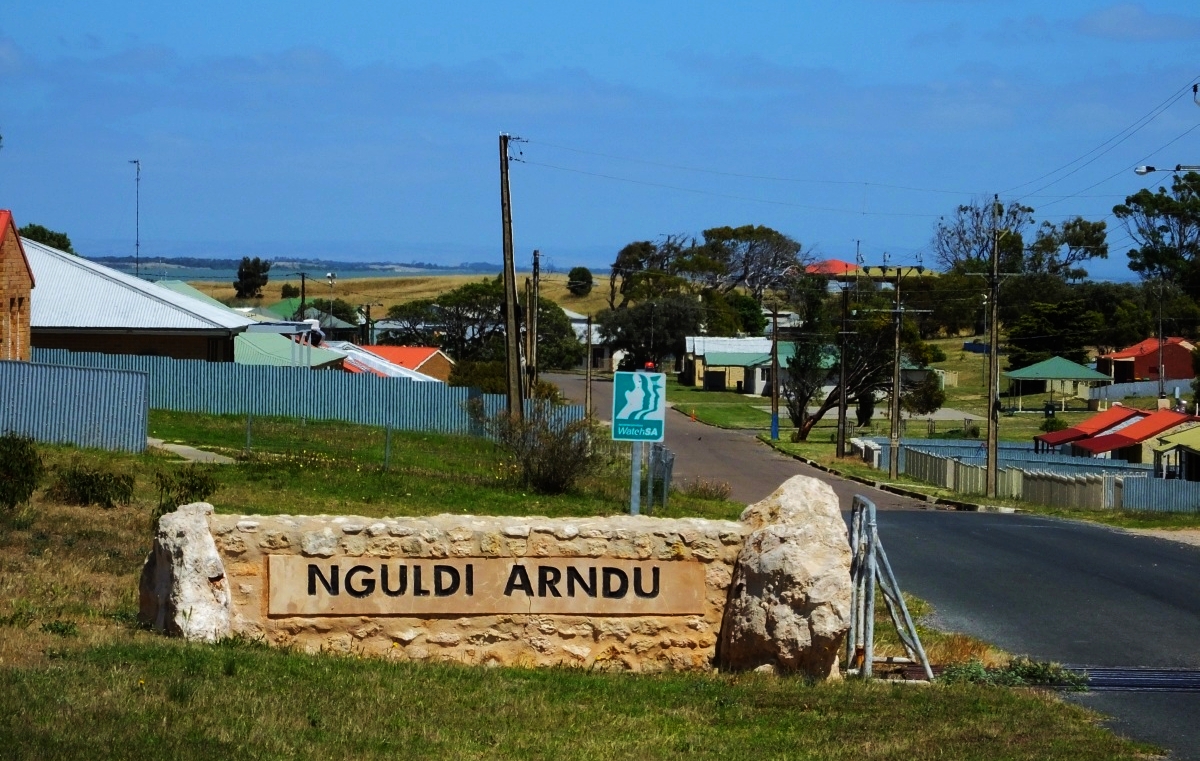
We waited for the Narrung ferry and then, just after noon, I stopped a few meters short of the town boundary. The stone gateway is marked Raukkan on one side, Nguldi Arndu on the other. 

It's an indigenous town: laid back, quiet, isolated, single storey building line, houses sprawled wide because there's elbow room aplenty -- fronting onto the vast blue expanse of the lake.

Jo read the roadside infoboards, shaded her eyes with one hand and wondered, 

 “How would I find a guy called Uncle Ben Campbell?”

Gateway to the town of Raukkan.

“Try the post office,” I suggested. “They'll definitely know where he lives. They won't hand out his address, but they can send a message. If he wants to meet, he'll be here.”

She peered back at the infoboard. “Post office...”

“Straight ahead on your right, past the clinic.” I pointed. “Look, I'll stay in the car. This is a family affair. You're the Campbells, I'm just the transportation.”

I watched her walk on into town and listened to quiet so profound, a warbling magpie seemed unpardonably loud. You don't hear such quiet in any city. I find it as humbling as it's pacifying … for a moment one realizes how infinitesimal humans are, lost in infinities of space we can't even visualize, much less comprehend.

Six assorted kids chased a soccer ball down the street; a crow called from the roof of the sandstone hall with the smart new galvanized roof; a flight of pelicans went gliding between Lakes Albert and Alexandrina, right over my head, white against the blue.

In fifteen minutes Jo jogged back up the road with a cautious smile and the wind in the copper-and-silver hair. “I'm invited to the drop-in centre for tea. Wanna be my 'plus one'?”

“For tea? Sure.” I was parched.

The drop-in centre is right by the old post office, facing the park. The kids were playing footy there now -- Aussie rules with a soccer ball, and a great time being had by all. Kids don't change, the world over; it's adults who write the rules, then break them every chance they get and make trouble. Jo and I settled in a corner of the centre, which was almost deserted at this hour. The chance to get out of the sun was welcome, and no cuppa tastes better than the one you didn't make yourself.

We waited half an hour for Ben Campell, and I held my breath, hoping for Jo's sake. She'd told me a little of her own story, and I knew she was the last of her clan from North America. The name disappeared when the daughters scattered across the globe with their husbands; after the world wars, only her father, another Jamie, remained to perpetuate the name. He passed away, leaving Jo the only surviving Campbell -- the last of her line who identified as Campbell. She'd lost touch with the distant cousins in Ontario, New Zealand, Illinois. One erstwhile Campbell daughter was said to be back in Scotland, but with the name gone and the bloodline diluted, they were difficult to find and seemed reluctant to correspond.

So here were the last actual Campbells descended from the intrepid Gordon and Donald. One was a six-foot, sturdy American; the other stepped in out of the sun, and I crossed my fingers. Ben Campbell was close to full-blood Ngarrindjeri. I stepped back, not wanting to be in the way. Someone at the post office had sent a coherent message, and Raukkan's surviving Campbell was as curious as the one from Portland, Oregon.

He was over eighty, but straight-backed, thin and wiry, with snowy hair and beard -- in bluejeans, sweatshirt, sneakers, the uniform of every generation. Ben studied Jo from under a white bush of brows. Dark eyes took her apart, limb from limb, and put her back together. I guess he recognized a fellow Campbell, because he brought out his wallet and produced an ancient photograph.

“Oh, my,” Jo whispered, and dug though her bag.

The two photos sat side by side on the table between the empty cups. Hers was a recent copy, faithfully reproducing every crease and scratch. His was old, fragile, printed on card, the original sepia, no hint of gloss. The same photo.

They pulled up chairs, sent for more tea and talked. They'd talk for hours, but I stayed just long enough to learn that Gordon married the local girl and fought with the family back home over it. He never had the chance to mention Maggie was Ngarrindjeri -- which could have been an issue a century ago -- because he'd originally promised to wait for his childhood sweetheart to arrive out here … both families back home were too furious to acknowledge another letter. A fire reduced his property to scorched earth in 1916, so he worked on a station between Clayton and Finiss until '24, and retired to Poltaloch, across the lake. His boy, Donald, married a full-blood Ngarrindjeri lass and had one surviving son to carry on the family name.

Benjamin was still alive and well, and living in Raukkan.

Jo and Ben had so much to talk about. They'd both forgotten me,so I wrote my name and number on a postcard and left it with the girl at the counter. If I was needed, they'd call.

With a smile I stepped back into the sun, hands in pockets, contemplating the drive back to Milang in the growing afternoon shadows.

oOoooOoooOo

This is fiction, though it's set in real places and the story is so perfectly possible, I'd actually be surprised if something similar hasn't happened. Maybe a Canadian tracking down Irish ancestors. 

Dave and I went right around Lake Alexandrina on my 2015 "birthday trip" -- that is, an overnight getaway, where we'll stay at the Milang Lakes motel on Saturday night, and be able to go further the next day, before turning for home. 

Here we are parked beside the infoboard described above -- the town gate is just out of frame to the right...


And here's the left-side poster you see in the little shelter there -- a kind of tourist guide to the Narrung and Corrong regions. (The image is uploaded at full size and is perfectly readable.) 

It's a gorgeous part of the world, one of my favorites. If you're interested, there's more about Milang, the Lakes District and so forth, on my old travel blog, Meander to the Max. I'm remembering four or five posts featuring Milang, so -- browse around, you'll find them.

(Dang, I need to do some work on the travel blog. There's about another 50 posts I need to make, without delay. More. Must set aside an hour or two here and there, and see what I can do.) 

Tuesday, January 25, 2022

Essay: A Milestone


There's a first time for everything, and although I've been published several times, and also at professional level, appearing in a very major magazine with full-on distribution is -- to me! -- an achievement, and a thrill. The contributor's copies of ANALOG Jan/Feb 2022 arrived yesterday, and how sweet it was to have it in my hand and chart this moment. The first step on a road which, I hope, will lead eventually to me marking a day, when I'm cradling a novel in both hands and making another milestone!

I did report the date when ANALOG accepted the story (before the launch of this blog, so it was marked on my personal blog, here on Dec 20, 2020); and  also posted my news when the issue was released a couple of weeks ago (here) -- but this is quite different. Actually having the magazine in my hands makes it ... real. 

It's also an inspiration to me, to be creative, keep driving forward. I do have stories to tell, and if one is completely honest, it can be a lot of fun telling them. I'd also like to write about writing, and in coming weeks and months I'll indulge myself here; but not at the moment when, after an absence of months, the muse has finally deigned to whisper into my ear. I'm hoping to complete a third story in as many weeks.

Updating this a little while later -- let's call that four stories in four weeks, and am about to start another! Eden Can Wait worked out well, though it came in at about twice the length I'd hoped for (about 10k, which will certainly make it harder to sell). However, A Marriage of Inconvenience came in at 3.5k, as did Dust Gets in Your Eyes, and from what I've come to understand about short story writing, this is close to the perfect length ... at least as far as editors understand it! 

Writers might have a different view. For myself, I find it very much more difficult writing a coherent short story than writing a novel. This might sound odd, given that there's twenty times more work (no exaggeration) in a novel than in a short story, but trying to cut a story to fit into a 2,000 - 10,000 word window is ... agony. It's pure torture, which simply means I'm not a natural short story writer. Right. 

Still, one perseveres -- and its also true that some story ideas will actually fall apart if they're treated at greater length. In fact, the story I'm about to write this afternoon is one of these ... so, time to get busy!